

Organizations today face risks that move faster than most policies can track. This review traces how risk management thinking has evolved. It covers the frameworks that anchor current practice, the debates that surround them, and the lessons that documented case experience offers rather than speculation.
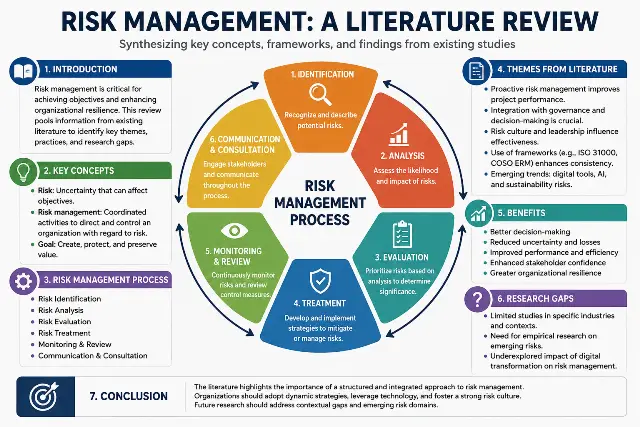
The shift matters beyond the academic. Boards now expect risk updates at every strategy meeting, not just annually. Investors scrutinize risk disclosure far more closely than they did a decade ago. Reporting requirements have also tightened well outside regulated industries like healthcare and banking. These pressures are pushing organizations to formalize practices that used to run on informal judgment. A well-organized literature review helps teams separate what’s actually proven from what’s simply trending. It also clears up a common source of confusion: different frameworks often use different words for the same underlying concept.
What “Cross-Modern” Risk Management Means
Cross-modern risk management blends established methods with cross-functional collaboration. It rejects the idea that risk belongs to one department. Finance, operations, IT, and compliance now work from a shared picture. This reflects an evolution in enterprise risk management (ERM) thinking over the past two decades.
Early risk models were narrow: insurance, financial hedging, and little else. Current practice treats risk as a factor in every business decision, because risk rarely stays contained. A supply chain disruption doesn’t stop at operations — it becomes a financial and reputational problem within days.
Why a Literature Review Approach Adds Value
A literature review compiles what other organizations have already learned. That way, a company doesn’t have to repeat the same expensive mistakes. Some ideas — scenario planning, for instance — hold up across decades of practice. Others, like purely quantitative risk scoring, have well-documented limits.
A good review doesn’t just list sources; it compares findings, flags contradictions, and points out where practice still has gaps. That structure gives decision-makers a clearer picture before they commit to a framework. It’s especially useful for smaller organizations that lack a dedicated risk research function, since they can build on established results instead of learning by trial and error.
Foundational Frameworks
A handful of standards underpin nearly every modern discussion of risk. Understanding them makes it easier to evaluate anything newer.
| Framework | Governing body | Primary focus | Best suited for |
|---|---|---|---|
| ISO 31000 | International Organization for Standardization | Principles and guidelines for embedding risk thinking into governance | Any organization, any size or sector — not certifiable, but broadly adaptable |
| COSO ERM | Committee of Sponsoring Organizations of the Treadway Commission | Integrating risk with strategy and performance | Organizations wanting risk built into strategic planning, not just loss prevention |
| Basel III | Basel Committee on Banking Supervision (BIS) | Bank capital adequacy, leverage, and liquidity | Banking and financial institutions, though its stress-testing logic has spread well beyond banking |
| Three Lines Model | Institute of Internal Auditors | Separating operational management, risk oversight, and independent assurance | Organizations formalizing accountability and audit structures |
ISO 31000: Flexible, Principles-Based Guidance
ISO 31000 gives organizations flexible, principles-based guidance rather than prescribed steps. Organizations can adapt it to almost any context. That flexibility is part of why it shows up as a reference point across construction, healthcare, and other sectors.
COSO ERM: Linking Risk to Strategy
COSO ERM most recently updated its framework in 2017. The update ties risk management directly to value creation, rather than treating it purely as a cost to minimize. Its five components are governance and culture, strategy and objective-setting, performance, review and revision, and information and communication. Analysts praise this structure for strategic alignment, though critics say it can feel abstract without real leadership buy-in.
Basel III: Capital, Liquidity, and Systemic Stability
Basel III emerged from the 2008 financial crisis and tightened capital and liquidity risk requirements for banks. Its influence has traveled well past banking. Stress-testing, originally a Basel III mechanism, is now common practice in hospitals, energy companies, and logistics firms. Research comparing large global banks with smaller regional ones consistently finds that compliance costs land disproportionately on smaller institutions. Even so, the framework strengthened sector-wide resilience overall.
The Three Lines Model: Clarifying Accountability
The Three Lines Model clarifies who owns what: operational management, risk oversight, and independent assurance each get distinct roles. Without that separation, distortion tends to creep into risk reporting. Governance literature raises this point repeatedly, and it’s one reason many organizations restructure internal audit around this model.
Traditional vs. Modern Risk Management
| Traditional approach | Modern (cross-functional) approach | |
|---|---|---|
| Structure | Siloed by department | Integrated, cross-departmental |
| Timing | Periodic review (often annual) | Continuous monitoring |
| Communication | Limited until issues escalate | Shared visibility before problems compound |
| Scope | Single-department consequences | Ripple effects across finance, legal, reputation |
| Example | A cybersecurity breach treated as an IT issue | The same breach treated as simultaneously financial, legal, and reputational |
This shift wasn’t sudden — it emerged as risks grew more interconnected than departmental models could capture.
Case Studies: Risk Management in Practice
Maersk and the NotPetya Attack (2017)
The NotPetya malware hit Maersk’s systems in June 2017. The shipping giant lost core IT infrastructure across ports and terminals in multiple countries. The company later disclosed the incident cost between $250–300 million and contributed to a $1.9 billion operating loss for the year. Total global damage from NotPetya reached an estimated $10 billion across all affected firms. The case is now a standard reference for how a single unpatched vulnerability can cascade into an operational, financial, and reputational crisis at once. It’s exactly the kind of cross-departmental impact that traditional, siloed risk models struggle to anticipate.
Silicon Valley Bank’s Collapse (2023)
SVB’s failure came from a combination of factors. Concentrated deposits from tech and venture-backed clients, heavy investment in long-duration bonds, and inadequate hedging against rising interest rates all played a part. Rate hikes eroded the value of its bond portfolio, forcing SVB to sell at a loss. That triggered a depositor run that pulled over $40 billion in a single day. A subsequent Federal Reserve review found that SVB’s own risk-management framework had understated its interest-rate and liquidity exposure. It hadn’t fully addressed either risk. Liquidity-risk literature widely cites the case as a reminder: organizations should revisit stress-testing assumptions, a Basel III-derived practice, as rate environments shift rather than treat them as fixed.
Microsoft and the 2024 Cyber Safety Review Board Report
A U.S. government review of a major cloud security incident found a gap at Microsoft. Its internal culture had not prioritized security risk management at a level matching the threat it faced. Governance literature frequently cites the report. It shows how even organizations with mature technical capabilities can fail on the “culture and governance” component that frameworks like COSO ERM place at the center of effective risk management. Frameworks only work if leadership visibly commits to them.
Emerging Themes in the Literature
- Interconnected risk mapping — studying how risks in one department trigger consequences in another
- Continuous monitoring — real-time tracking replacing static, periodically-updated risk registers
- Behavioral risk factors — how human judgment shapes risk perception and response quality
- Climate and environmental risk — now a standing agenda item rather than a separate conversation
- Third-party and supply chain risk — growing scrutiny of vendor dependence
- Geopolitical risk — trade and regulatory shifts increasingly built into scenario planning
- Talent risk — losing experienced risk staff to competitors erodes institutional memory over time
Technology’s Role — With a Caveat
Predictive analytics and automated dashboards have replaced spreadsheet-based tracking in many organizations, surfacing patterns humans might miss. But the literature is consistent on one point: technology works best paired with human judgment, not as a replacement for it. Algorithms don’t recognize context the way experienced staff do. Poor data quality can also generate false alerts just as easily as real ones.
Cloud-based platforms have also changed how teams collaborate on risk data. Multiple departments can now update shared registers simultaneously, cutting the delays common in email-based reporting. The trade-off worth weighing before a major platform investment is vendor lock-in. Switching systems mid-stream is expensive, so data portability deserves attention at the selection stage, not after.
Enterprise Risk Management: Strategy and Risk Together
Modern ERM treats risk as part of strategic planning, not as a separate conversation that happens after leaders have already decided. Entering a new market, for example, carries both opportunity and new regulatory exposure. Organizations that discuss the two together tend to build more realistic, resilient plans and recover faster from disruption.

Key risk indicators (KRIs) play a central role here: metrics that flag emerging problems early, ideally combining quantitative measures with qualitative expert judgment. Relying on numbers alone tends to miss risks that haven’t fully materialized yet. Some researchers call this pairing the backbone of a mature ERM program.
Sector-Specific Applications
Healthcare Risk Management Practices
Emphasis falls on clinical and financial risk together. Predictive tools increasingly flag potential patient-safety issues, and staff training remains central to reducing preventable errors.
Manufacturing and Supply Chain Risk
Diversifying suppliers and holding buffer inventory of critical materials have both gained traction, accelerated by the disruptions of recent years.
Technology Sector Risk Considerations
Cybersecurity and data privacy dominate. A persistent tension exists between fast product cycles and thorough security review, which is one reason more companies now embed security audits directly into development instead of treating them as a final gate.
Financial Services Risk Trends
Fraud detection increasingly combines transaction monitoring with behavioral pattern analysis, catching unusual activity faster than manual review. Regulatory reporting obligations continue to consume a significant share of compliance team resources.
Public Sector and Nonprofit Risk Management
Budget constraints often rule out advanced risk software, so literature in this space favors low-cost, practical assessment methods. Public trust and transparency carry more institutional weight here than in private-sector risk programs, which tend to prioritize confidentiality instead.
Common Implementation Challenges
- Cultural resistance slows adoption of integrated risk practices
- Data silos prevent teams from sharing risk information effectively
- Resource limits constrain smaller organizations from building full programs
- Reputational risk remains genuinely hard to measure
- Leadership turnover disrupts long-term risk strategy continuity
- Inconsistent terminology across departments (finance and operations often define “risk exposure” differently) slows cross-functional discussion
- Overly complex processes discourage frontline staff from reporting issues early
A shared glossary and simpler reporting steps are two of the lowest-cost fixes the literature points to repeatedly.
Best Practices for Implementation
- Define and formalize a risk appetite statement with leadership sign-off
- Build cross-departmental risk committees rather than isolated risk teams
- Favor simple, readable dashboards over dense reports
- Run scenario planning regularly, not just annually
- Train staff at all levels to identify and report emerging threats
- Revisit and adjust frameworks as business conditions change
None of these require a large budget. Organizations that treat risk management as an ongoing practice, rather than a one-time project, consistently show better long-term outcomes in the literature.
An Analyst’s Take
The frameworks above tend to converge on one idea despite using different vocabulary: risk that stays siloed in one department is risk nobody discovers until it’s too late. What the Maersk, SVB, and Microsoft cases share isn’t a common cause. One is a cyberattack, one is interest-rate mismanagement, one is a culture failure. What they share is a common failure mode: in each case, risk signals existed somewhere in the business before the event, but never reached the people who could act on them in time. That’s less a technology problem than a communication-structure problem. It’s probably why “cross-functional visibility” shows up as a recurring theme across nearly every framework in this review, regardless of which industry or discipline produced it.
Where the Research Is Heading
Climate-related risk and AI governance are both growing areas of academic interest. Open questions remain around accountability when algorithms inform risk decisions. Interdisciplinary work is producing more useful findings than single-discipline research alone. Economists, psychologists, and data scientists studying risk together have made particular headway on why organizations underestimate low-probability, high-impact events, a well-documented pattern in behavioral economics. Academic-industry partnerships are also becoming more common. They give companies access to rigorous research methods and give researchers real operating data to test theories against.
Final Thoughts
ISO 31000, COSO ERM, and Basel III remain the foundation of modern risk practice. Current thinking layers integration, real-time monitoring, and strategic alignment on top. Technology adds real value when paired with human judgment, not in place of it. The organizations that fare best tend to start small and get leadership involved early. They treat risk management as a continuously evolving practice rather than a fixed policy.
Reading the Evidence Critically
A literature review is only useful if it distinguishes what the research actually establishes from what it merely suggests. Three cautions are worth carrying into any reading of this field.
ERM performance claims are correlational, not causal
Studies associating mature ERM programmes with stronger financial performance are common, and they are frequently cited as though the causal direction were settled. It is not. Well-resourced, well-run companies are both more likely to invest in a formal ERM programme and more likely to perform well for reasons unrelated to it. Separating “ERM improved performance” from “companies that were already succeeding could afford good ERM” is genuinely difficult, and most published work does not manage it convincingly.
This does not mean ERM lacks value. It means performance figures should be treated as directional evidence rather than proof, particularly when they appear in vendor material or consultancy reports.
Basel III is cited more often than it applies
Basel III is a banking capital and liquidity standard. Its stress-testing logic has genuinely influenced thinking elsewhere, but it turns up in general risk management discussions far more often than its actual relevance warrants — largely because it is the most recognisable name in the field. Outside financial services, ISO 31000 or COSO ERM will almost always be the more applicable reference point.
Evidence maturity varies sharply by risk type
- Credit and financial risk is the most quantitatively developed branch — decades of statistical work on default probability and credit scoring, now supplemented rather than replaced by machine learning models trained on larger and messier datasets.
- Operational risk research leans qualitative, built on case studies of specific failures — fraud, system outages, human error — because operational failure modes resist clean statistical modelling. Cybersecurity incidents have dominated this branch over the past decade.
- Market and liquidity risk are increasingly studied together rather than separately, because 2008 demonstrated that a market shock and a liquidity crunch tend to compound each other rather than occur independently.
Weighting a quantitative finding from credit risk research the same as a qualitative operational risk case study is a common analytical error. They carry different kinds of evidential weight.
Where the Research Falls Short
Four gaps in the current literature are worth stating plainly, because they determine how far published findings can be relied on.
- Small and mid-sized organizations are underserved. The overwhelming majority of published research studies large corporations and banks. There is comparatively little rigorous work on how a fifty-person firm should scale these frameworks down, which leaves smaller organizations adapting guidance built for a very different context.
- Emerging risks outpace publication cycles. By the time peer-reviewed research on a given AI-driven fraud pattern or geopolitical supply-chain disruption reaches publication, the landscape has often already shifted. For genuinely new risk categories, documented practitioner experience is frequently more current than the academic literature.
- Cross-industry comparison is rare. Most studies stay within a single sector — banking, healthcare, manufacturing — so transferable lessons across industries remain underdeveloped. Whether a leadership practice that works in construction transfers to a clinical hierarchy is largely untested.
- Long-horizon outcome data is scarce. Most studies measure effectiveness over one or two years. Whether a given approach holds up across a full economic cycle is a question the literature rarely answers.
Practical Implications
Reading the above, four working conclusions follow:
- If you operate outside banking, start from ISO 31000 — it is the most broadly applicable and least resource-intensive reference point to build on.
- Treat ERM performance claims as directional rather than proven, and be sceptical of precise figures attached to them.
- For anything genuinely new — AI-enabled fraud, novel supply-chain exposures — weight qualitative case evidence heavily, because the statistical literature has not caught up.
- If you are a smaller organization, expect to adapt rather than adopt. The published research will not hand you a ready-made playbook at your scale.
None of this substitutes for conducting your own risk assessment. What the literature does well is stop you repeating mistakes that are already thoroughly documented, and help you judge which framework and which body of evidence actually apply to your circumstances — rather than defaulting to whichever appears first in a search result.
Frequently Asked Questions
What is cross-modern risk management?
An approach that combines traditional risk practices with newer, technology-driven and strategic methods, applied across departments rather than confined to one function.
Why does a literature review matter to a risk manager?
It surfaces what’s already been learned elsewhere, helping teams avoid repeating known mistakes and identify which methods have actually held up over time.
What’s the most widely used risk management framework?
ISO 31000 and COSO ERM are the most commonly referenced globally, though the right choice depends on industry, organization size, and regulatory context.
Can technology replace human judgment in risk management?
No. Predictive tools are valuable, but they can miss context and generate false signals without an experienced person interpreting the results.
Why do many risk management programs fail to gain traction?
Common barriers include cultural resistance, departmental data silos, limited resources, and inconsistent leadership support.
How does the modern approach differ from the traditional one?
Traditional approaches were siloed and reviewed periodically; modern approaches favor continuous, cross-departmental collaboration that accounts for how risks connect across the business.
Is enterprise risk management only relevant for large companies?
No. Smaller organizations can apply the same principles at a smaller scale — a simple risk appetite statement and a cross-functional committee go a long way.
How is climate risk treated in current risk management literature?
As a standing operational and financial consideration integrated into planning, rather than a separate sustainability conversation.
External references:
ISO 31000:2018, Risk management — Guidelines. iso.org
COSO, Enterprise Risk Management — Integrating with Strategy and Performance (2017). coso.org
Basel Committee on Banking Supervision, Basel III: A Global Regulatory Framework for More Resilient Banks and Banking Systems. bis.org
Federal Reserve, Review of the Federal Reserve’s Supervision and Regulation of Silicon Valley Bank (April 2023). federalreserve.gov

