

The financial market is a dynamic market. The interest rate, assets price and currency value can change rapidly; this may be a challenge for businesses and investors. This never-ending movement poses a serious risk to financial stability for business and investors. Market risk management is designed to solve just this problem.
All organizations, regardless of whether they are aware of it or not, are exposed to some level of markets. A foreign retailer is subject to currency fluctuations. Pension fund with bonds is subject to interest rate changes. The buyer of raw materials at a manufacturing level is subject to commodity price fluctuations. None of these organizations can have direct control over the market, but each can have control over the readiness of the market when the conditions change.
This article provides an overview of the meaning of market risk management, its importance and practical implementation. Real strategies, proven structures and practical examples of how professionals manage financial exposure today. The principles of a small-scale trading business and a large-scale one are the same, albeit the size and the tools are different.
What Is Market Risk Management?
Market risk management is the systematic approach to risk identification, risk measurement and risk control associated with fluctuation of financial markets. This kind of movements includes fluctuations in interest rates, stocks, currency and commodity prices.
Market risk is not about a borrower’s capacity to repay, as is credit risk; rather it’s about wider economic factors. These are forces that a company can’t control. It can only get ready for them.
Market risk management is a process of managing risk, not risk elimination. Market volatility is the nature of markets and is part of it. Rather, the intent is to know how it works, minimize risk of harm and safeguard future financial stability.
All banks, investment companies and corporations use this discipline in some form. While the tools used will vary, the principles for a manufacturing business looking to hedge currency exposure and a bank looking at interest rate risk are essentially the same.
This art has become more advanced in the last several decades. Early RM was dominated by intuitive and general diversification strategies. Today, companies have some quantitative models, real-time data feeds and special risk committees to monitor exposure on the fly. This change mirrors an interconnection of markets around the world, in which a shock in one region can quickly spread to other regions.
It also bears witness to the lessons learned from previous financial crises. For instance, the 2008 global financial crisis revealed the shortcoming of poorly measured market exposure which could lead to systemic failure. Those institutions that remained in business tended to have more robust risk controls, defined limits, and more transparency as to actual exposure throughout trading desks and business units.
Why Market Risk Management Matters for Businesses
There is a risk involved in the market which can cause huge financial losses if ignored. Profit margins can be instantly destroyed if there is a sudden devaluation of the currency. If interest rates rise, it could become impossible to pay off debts. These are not uncommon occurrences; they occur on a regular basis all over the world’s markets.
Market risk management is a crucial pillar of organizational balance sheet resilience to such shocks. It also facilitates improved decision making as leadership is aware of the exposures before investing capital into new investments or projects.
Regulators also want the financial institutions to be more mature in their risk practices. Under the capital adequacy rules banks are required to hold reserves that are in proportion to their risk exposure. If market risk is not properly managed, it can lead to regulatory sanctions and damage to the company’s reputation.
Compliance is not all there is, there is a competitive advantage too. Risk disciplined companies bounce back quicker from the downturn. They can also secure better interest rates, as they are perceived as less risky borrowers.
Investors and stakeholders are also keenly interested in the level of market exposure a company is able to manage. A strong risk management frame indicates strength and stability, which in turbulent times can affect share prices and investor confidence.
There’s also something that many people don’t think about, an operational dimension. When market risk is not managed, finance teams are too busy firefighting, rather than moving forward. A proper risk management framework frees up resources so that the management can devote attention towards growth instead of damage control. This new way of doing things from reactive to proactive over time can become a real competitive advantage, especially in sectors that already have slim profit margins.
Types of Market Risk Every Organization Should Know
Market risk is not a uniform risk and it is not a one-size-fits-all type of risk. It comes in various different forms and each of these needs a different monitoring strategy and mitigation tool.
Interest Rate Risk
Interest rate risk occurs when an instrument or asset (such as a loan) whose value is influenced by interest rate changes is affected by changes in the benchmark rate. If rates increase, a company that has variable-rate debt will have to pay higher interest rates.
Banks are particularly vulnerable as they are primarily engaged in the business of borrowing on a short-term basis and lending on a long-term basis. When interest rates start to rise, the conflict between these time frames can cause profits to be quickly squeezed.
This risk is also felt by the bondholders. As rates go up, the price of the bonds generally goes down, as newer bonds may be more appealing. It is important for fund managers with large fixed-income portfolios to closely monitor this relationship to prevent any unactioned losses in valuation.
Equity Price Risk
Losses of stock prices are covered by equity price risk. This is an exposure of investment funds, pension plans and corporations with equity holdings.
This risk is more likely to be present during large market corrections when the shares of even strong fundamentals fall in the market.
This danger escalates even more in the case of concentrated equity positions. Diversification is a major principle in practice and is also the very basis of a successful investor who has a large holding in one company, as compared to a small holding in dozens of companies, has far greater volatility.
Currency Risk
For businesses that conduct trade trans-border transactions, currency risk management becomes a must. Rising or falling exchange rates can make a profitable export contract lose value if the local currency depreciates.
This risk can be experienced by multinational enterprises in many aspects such as collection of revenue, supplier payments and foreign asset valuation.
Indirect currency risk can even impact businesses that primarily trade within a single country. Even if an importer never deals in foreign currency, exchange rate fluctuations are still felt on the domestic market by the local product manufacturer who has to buy the raw materials at an increased or decreased price.
Commodity Price Risk
Commodity price risk is a risk faced by businesses that use raw materials like oil, metals, or agricultural produce. Surprising increases in input prices can squeeze profits when prices are not immediately passed on to the customers.
This type of market risk is of particular concern to airlines, manufacturers, and food producers.
Liquidity-Linked Market Risk
The other, not so widely discussed, dimension is the relationship between market risk and liquidity. When the market is in periods of extreme volatility, some assets can be more difficult to sell without taking a significant discount. This can also mean that the reported value of a position may not be representative of the position’s likely going rate if it were sold quickly, and complicates overall risk exposure.
Core Components of an Effective Market Risk Management Framework
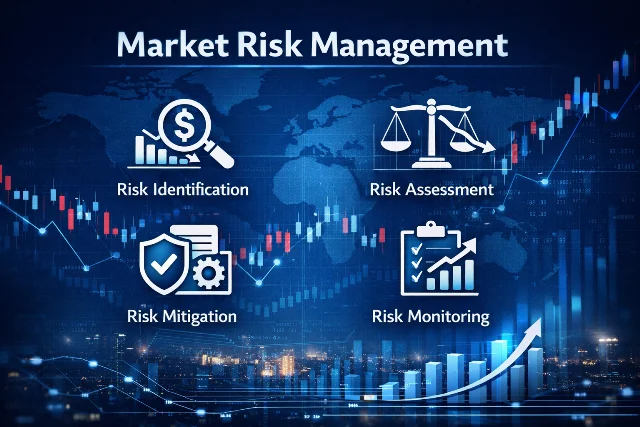
The four interdependent elements of a sound market risk management system are:Four elements of a sound market risk management framework are: It is not a system that can withstand skipping any one of them.
Risk Identification
The first step in the process is the identification of all the sources of risk exposure within the organization. This involves the contract review, debt forms, foreign transactions and investment holdings.
Risk teams who are experienced are able to identify exposures systematically, not just have an awareness of the exposures. Unexpected losses later are frequently caused by a missed exposure.
Often this requires integration with other departments. Each of the finance, procurement, sales and treasury teams has its own segment of the exposure picture and when these segments are taken together, the risk map is far more complete than it would be if any one team could have created it by itself.
Risk Measurement
After risks are identified they need to be quantifiable. This normally entails statistical models that forecast possible losses in various market conditions.
Measurement converts speculation into information. It is essential if there is no one to do the risk assessment and prioritize mitigation efforts.
Some typical ways of measurement are sensitivity analysis, which tells you what the impact of a given market movement is expected to be for a given position, and correlation, which helps you understand that certain exposures may be moving in concert during a crisis, which could lead to a higher loss of value than if the exposures moved independently of one another.
Risk Monitoring
Measurement isn’t enough – markets are constantly changing. An ongoing monitoring process is in place to monitor the evolution of exposures, as the prices, rates and currencies change each day.
Many organisations have dashboards that can alert teams to exposures that are approaching pre-defined thresholds, permitting teams to act BEFORE losses are acquired.
The frequency of monitoring should reflect the volatility of the exposure being monitored. What constitutes proper monitoring for the trading desk could be different from what works for the corporate treasury with long-term currency exposure, and might occur on a real-time basis or a weekly or monthly basis.
Risk Control and Mitigation
The last one is taking action with the data. This may involve hedging, diversification or rebalancing assets to limit exposure to one asset.
Any control measures need to be commensurate with the risk appetite of the organization and with the level of risk that it is prepared to accept in terms of mitigation.
This is where documentation is important too. All mitigation decisions should be documented including why, to assess future if its approach was effective.
Proven Market Risk Management Strategies
The core of professional programs of market risk management is several practical strategies. Most organisations use more than one approach.
Diversification
A diversified portfolio across asset classes, sectors and geographies minimizes the effect of any one market movement on a portfolio. This diversification tactic is still considered one of the oldest and most effective risk management techniques.
An industry-focused portfolio is hit particularly hard by a downturn in the industry. A diversified portfolio takes the blow at a more even pace.
Diversification is more than just holding a lot of assets. It involves picking positions that might not go up or down together at the comparable time, because two or twenty correlated positions might be just as protected as one.
Hedging with Derivatives
The hedging strategies involve the use of financial products such as futures, options and swaps to protect from possible losses. If a company thinks that it will receive foreign currency in 6 months, it can sign a forward contract at the current exchange rate to ensure that the foreign currency is exchanged at the agreed rate.
Derivatives trading should be done with expertise as poorly structured hedges can create new risks rather than mitigating the existing risks. Numerous companies have special treasury teams that can be utilised for creating such strategies carefully.
Options are particularly flexible because they allow the investor to benefit from a good play and avoid a bad one, at the price of paying up for this choice.
Value at Risk (VaR) Modeling
Value at Risk ( VaR ) gives an estimate of the largest loss that can happen over a period of time within normal market conditions. A firm, for instance, may determine its portfolio has a 5% chance of having losses greater than a certain amount in any one week.
While VaR should be used with other measurement tools, it provides a single and digestible number for leadership to communicate to boards and regulators the risk exposure that is present.
There are several different methods for calculating, such as historical simulation, variance-covariance methods, and Monte Carlo simulation. There are different assumptions used for each and risk teams may implement more than one technique to confirm the results.
Stress Testing and Scenario Analysis
Stress testing evaluates the performance of a portfolio under extreme but plausible conditions, like a financial crisis, or a sudden shock in interest rates. This approach uncovers risks that conventional VaR models may fail to identify.
This is complemented by scenario analysis, which simulates particular hypothetical situations like a big currency devaluation or a collapse in commodity prices.
To detect financial system vulnerabilities before they become a problem to the banking system as a whole, regulators are increasingly mandating that banks conduct annual stress tests using common standards, and that the results are compared with those of other banks.
Setting Risk Limits
Clear boundaries to exposure ensure that no single posture is jeopardizing the stability of the organization. The limits are set by the company’s overall risk appetite, and are reviewed regularly, responsive to market conditions.
Limits also provide accountability, as traders and managers are aware of the exact amount of exposure they are allowed.
Any violation of the predetermined limits should be automatically reviewed, whether it is the position that is profitable or not. When it comes to a single lucky event in this discipline, the idea is to avoid excessive risk taking in the future.
Market Risk Management Frameworks and Standards
Organizations can rely on existing structures to get a head start on handling market risk, rather than developing processes from the ground up.
Basel III Framework
The Basel III framework is widely adhered to by banking institutions, and requires minimum capital requirements for banking institutions, determined by risk-weighted assets. It mandates buffers that cushion against losses in the market during stress periods for banks.

Basel III also included more rigorous requirements on liquidity coverage, to make sure that banks have the liquidity needed to satisfy obligations even under extreme market pressures.
The framework was developed directly from the lessons learned from the financial crisis of 2008, which showed that many banks had very shallow capital buffers to withstand the losses they suffered.
ISO 31000 Application to Market Risk
ISO 31000 offers guidelines on the overall principles of risk management that can be applied to market risk. Its identification, analysis, evaluation and treatment process is not finance-specific, but it is applicable to market exposures.
The ISO 31000 is frequently adopted as a starting point for companies not in the banking industry, which can then add further finance-specific tools, such as VaR.
ISO 31000 is a principles based standard, this allows organizations to tailor it to their size and complexity to make it accessible even to smaller organizations that do not have a dedicated risk department.
Real-World Examples of Market Risk Management
One example of a company that uses a lot of jet fuel is an airline. Airline takes commodity price risk by fixing fuel prices in advance in futures. This helps to maintain operating margins even in the face of unexpected price increases in oil.
Another instance is a technology exporter that has its production costs in local currency but sells in Europe in a different currency. The company enters forward contracts to hedge against currency risk management exposure for anticipated revenue.
Another example would be investment funds. Retirement funds purchase assets in many different countries, bonds, and stocks. The portfolio risk management approach helps decrease the risk that a particular downturn might compromise the retirement income of the beneficiaries.
Let’s take the example of a regional bank. As interest rates rise, the bank will reduce the average life of their portfolio of loans and lengthen the life of their portfolio of deposits. This adjustment will minimize the mismatch between assets and liabilities, which will not significantly affect profitability should further rate increases be made.
The other helpful case is a commodity trading company. The firm does not allow for large unhedged positions, and each trading desk has daily loss limits. If a desk starts to become overloaded, then things will automatically get cut back without risking the overall stability of the firm because one bad day on that desk can be the one that causes the problem.
Each of these examples has a common theme in that each organization found that they were exposed to something different and used a specific tool instead of a generic solution.
Common Mistakes in Market Risk Management
Even experienced organizations make mistakes that negatively affect their risk management. Identifying these errors can prevent unnecessary duplication of effort.
Implementing just one model is one of the common mistakes made. VaR is useful but, using it as the sole indicator of risk will lead to blind spots, particularly when the market happens to be in unusual periods that don’t fit the historical pattern.
The other error is not having a consistent monitor. There are some companies which will do a comprehensive financial risk assessment at the beginning of a project, but do not monitor risk exposure throughout the project. Markets move very rapidly and obsolete judgments become worthless very soon.
Communication challenges between risk teams and decision makers also pose issues. Risk data is only valuable when it is understood and acted upon. Reports which are filled with technical jargon are ignored instead of being applied.
Last but not least, some organizations over-hedged, which unnecessarily introduces costs and complexity. A good hedging strategy is not to exceed exposure.
Another error that is often made is to view risk management as a one-time project rather than a practice. Businesses can create a solid back-bone, but fail to maintain it as the company grows or goes into new territories. Minor exposure at initiation may prove to be great exposure in a few years, and periodic review is necessary.
One last error to note is an underestimation of the correlation risk. What may seem unrelated job positions in a normal market can become closely correlated in a crisis, sometimes referred to as a correlation breakdown. Failing to take this into account can lead to risk teams losing a benefit they are after, namely diversification.
Building a Market Risk Culture in Your Organization
Without the proper organizational culture, frameworks and models are no more. All levels of employee should be aware of how their decisions impact on market exposure.
Training programmes are developed to enable staff to identify risks early, not just the specialised teams for risk. For example, a sales team that is involved in negotiating contracts internationally should have an understanding of basic currency risk management.
Leadership commitment is also a factor. If executives are serious about risk management and not simply performing a compliance procedure, then teams will take it more seriously.
Routine reporting cycles ensure that the risk can be seen throughout the organisation. Exposure data is provided on a monthly or quarterly basis and is provided to decision makers regularly, not only during crises.
Culture is also heavily shaped by incentive structures. In the absence of risk-reward considerations in bonuses, people might take on too much risk to earn large rewards. Stabilizing incentives, not just short term profits, into the daily decision-making process helps ensure good risk practices are in place.
Future Trends in Market Risk Management
Companies are still dealing with market risk management through technology. The machine learning models now analyze larger data sets and detect patterns that would be unnoticed by traditional statistical methods.
Older systems that would update risk data periodically are being replaced by real-time monitoring systems as the standard. This change enables quicker reaction to unexpected fluctuations in the market.
Financial risk is also being discussed due to climate change. Environmental risk is becoming a growing concern for regulators, who are increasingly looking to understand the impact on assets and systemic risk at the industry level.
Going forward cross-border risk assessment will likely be even more critical to the planning of organizations’ market risk management strategies, as markets become further and further connected worldwide.
How are risk limits being enforced is also evolving as a result of automation. Some trading systems have built-in controls that prevent or alert traders where pre-programmed levels are exceeded, eliminating the risk of human oversight error in fast-moving market situations.
Choosing the Right Market Risk Management Tools
Effective selection of tools is a critical consideration associated with the size of the organization, industry and exposures involved. If you are running a small import/export trade business, your currency exposure might only be as simple as a basic spreadsheet. And you may only need to use basic forward contracts. An enterprise-grade risk software that can simulate thousands of scenarios per day would instead be needed for a large bank.
Price is a factor but it should not be the sole factor. The budget is an important consideration, but if a tool is chosen just because of cost, that means there is a substantial amount of exposure that is not being monitored and often that exposure is more costly than the savings in software when the market shock hits.
Existing system integration is also important. When risk management tools are integrated with the accounting, treasury, and trading platforms. Exposure data are automatically updated, and the tools are more effective. Manual methods also add time delays and risk for human error, especially when markets are active and needn’t miss a beat.
Risk Measurement
Cloud-based risk platforms that integrate risk measurement, monitoring and reporting into a single platform are popular with many mid-sized companies. These platforms can also have customizable dashboards. Permitting risk teams to create customized views based by business unit or exposure sort without requiring a lot of technical skills.
Regulatory alignment must also be taken into consideration when selecting vendors. A tool that must be adopted by a bank that is subject to Basel III requirements should be able to model the specific capital calculations that regulators are expecting. Whereas a non-financial corporation might want a simpler tool to model scenarios. This ensures that investments are not wasted on unnecessary features and the budget is not exceeded.
Lastly, organizations need to review their tools from time to time, to see if they are still meeting their requirements. As a business grows, faces new markets and introduces more complicated instruments to trade, it may outgrow its existing risk management configuration within 12 months or so, which is why periodic technology reviews are as critical as strategy reviews.
Key Metrics Used to Track Market Risk
In addition to VaR, a number of measures can assist a risk team to develop a comprehensive exposure profile. Duration is a useful tool in the hands of a fixed-income manager to help him/her manage interest rate risk. It indicates the sensitivity of the price of a bond to changes in interest rates.
Beta indicates a stock’s price volatility compared to the overall market. The beta of a stock greater than one will tend to be larger than the market. This will affect how equity price risk is measured in a portfolio.
The Sharpe ratio measures returns against the risk incurred to generate those returns, and can help investors determine if they have been getting more return than their risk deserves. This adjustment may make it less appealing to return the high returns that come with high risk taking.
These metrics are tracked as a group and not by any one number. To provide a more comprehensive and accurate picture of the overall risk exposure in the holdings of an organization.
Conclusion
Market risk management helps organizations safeguard themselves against financial market volatility. Diversification, hedging and structured approaches such as Basel III and ISO 31000 enable businesses to mitigate risk and achieve growth. Effective risk management and regular monitoring transforms uncertainty into manageable exposure. There is no certain way to completely prevent risk, but all risks can be managed with disciplined preparation to keep the outcome a resiliency rather than disruption. First, check your existing exposures and then create a risk framework that aligns with your organization’s objectives and risk tolerance.
Frequently Asked Questions
What is the main goal of market risk management?
The primary objective is to recognize and reduce possible losses due to market fluctuations and not to take the risk out of everything. Organizations want to know what they’re exposed to and manage it to be within a reasonable level.
What is the difference between market risk and credit risk?
Market risk refers to general economic conditions such as interest rates and fluctuations in currency. Credit risk is a risk associated with the borrower’s capacity to repay. Assessment techniques are different for both.
What is Value at Risk (VaR) used for?
Tthe amount that a portfolio could potentially lose over a defined time horizon, in normal market conditions, according to VaR. It allows leadership to effectively communicate risk exposure to the Board and other regulators.
Are there market risk management strategies that are available to small businesses?
Indeed, in cases of currency volatility or commodity price fluctuations, small businesses can take advantage of simplified hedging tools. While it might not be as large as large institutions, the principles are the same.
Is hedging the only option when it comes to managing market risk?
Not always. The purpose of hedging is to align the amount of it with the exposure, which increases the cost and complexity. Excessive hedging may not increase returns commensurate with the increases in risk.
What is a reasonable interval for a company to review its market risk exposure?
Most organisations will review exposure on a monthly or quarterly basis. Although in fast moving markets this may be more often. By conducting regular reviews, risk data remains up to date and actionable.
How does diversification help to lower market risk?
Diversification involves spreading investments across various assets, sectors and regions. That means the blow of any one market downturn is minimized because one market can have a downward trend while another remains stable.
Is there a need for formal market risk management programs by regulators?
For banks and other financial institutions, there are frameworks such as Basel III. Which requires capital reserves to be based on risk exposure. Different industries and jurisdictions have different requirements.

