

Megaprojects are schemes costing more than £1 billion — railway lines, power stations, major transport hubs. Risk management means detecting and mitigating threats early. It also means capturing opportunities that improve outcomes. UK megaprojects sit under heavy public scrutiny. Taxpayer money, political reputations, and national infrastructure all ride on delivery. A single uncontrolled risk can trigger huge delays. This is why risk governance structures need to be in place from day one. For experienced sponsors, risk management isn’t an add-on; it’s core to how the project is run.
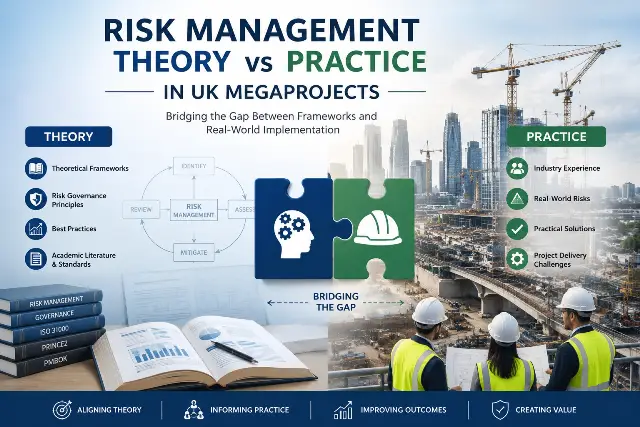
The scale of the challenge is significant. The government’s core portfolio of major projects, the Government Major Projects Portfolio (GMPP), carried a combined whole-life cost of £924.2 billion in 2025–26. Of the 189 projects reported, only 15% earned a Green delivery-confidence rating. 58% were Amber and 18% Red, according to the National Infrastructure and Service Transformation Authority (NISTA). These figures make the case for formal governance rather than good intentions alone.
Why Megaprojects Face Unique Risk Challenges
Megaprojects differ from smaller construction jobs in both scale and exposure. Dozens of contractors, subcontractors, and government agencies must coordinate. This often happens over a decade or more — long enough for economic conditions, political leadership, and public opinion to shift several times.
Supply chains can seize up overnight. Ground problems on a rail tunnel might only surface halfway through construction. Courts can uphold challenges to planning permission, adding years of delay. These risks compound each other: delayed funding triggers contractor claims, which drive up costs through inflation. Understanding how tightly these threats are interwoven has to come before any mitigation plan is designed.
Key Risk Categories in UK Infrastructure Projects
Clear categorization is the starting point for effective risk management. It lets teams assign ownership and track exposure systematically.

Financial and Funding Risks
Megaproject funding models are complex, blending public reinvestment, private financing, and international loans. Cost escalation is the most commonly reported financial risk on UK schemes. It’s driven by material prices, currency swings, and inflation. On HS2, for example, inflation alone accounts for roughly a third of the most recent cost increase. Reviewers have noted that inflation assumptions weren’t updated often enough over the programme’s life.
Government priorities can also shift mid-project, opening funding gaps. The National Audit Office has repeatedly flagged optimism bias in early cost estimates as a recurring problem. Projects that build contingency reserves in from the start handle this risk far better. Regular independent cost reviews catch run-ups before they escalate.
Regulatory and Planning Risks
Planning permissions, environmental assessments, and heritage protections make the UK’s regulatory environment for infrastructure genuinely complex. The largest schemes fall under the Nationally Significant Infrastructure Projects regime. Judicial reviews can halt construction for months or years. Several major UK projects have already faced successful legal challenges from environmental campaigners.
Prompt, clear stakeholder engagement cuts litigation risk substantially. Building compliance testing into every project stage, rather than bolting it on later, avoids expensive retrofits. Teams also need to track regulatory change closely. The Planning and Infrastructure Act 2025, for instance, has already reshaped how developers approach consenting in England and Wales — a reminder of how fast the landscape can shift.
Construction and Technical Risks
Physical construction carries unpredictable variables: ground conditions, weather, and engineering complexity chief among them. Geology is a particular concern for tunneling projects. Bridges and rail lines demand tight structural tolerances. A design error caught late can trigger costly rework.
Technical risk assessments carried out before ground-breaking go a long way toward reducing this exposure. Bringing in specialist geotechnical engineers early has paid off on most UK rail schemes. Ongoing site audits during construction catch quality problems before they compound.
Stakeholder and Political Risks
Megaprojects involve dozens of stakeholders with conflicting priorities. Local communities, government ministers, contractors, and investors all have a stake. Political risk can shift project priorities almost overnight. A change of government has previously halted or cancelled UK infrastructure commitments outright, as happened when the northern leg of HS2 was cancelled in 2023.
Mishandled public opposition can escalate into sustained protest, while clear communication builds trust and defuses resistance. Setting up community liaison panels early reduces disruption later. Political risk can’t be eliminated, but it can be managed. Managing it well makes a measurable difference.
Risk Governance in UK Megaprojects
Good risk management rests on clear governance, not just good intentions. UK public infrastructure typically follows a three lines model. The project team forms the first line, owning and managing risk day to day. Portfolio functions, commercial teams, and internal assurance make up the second line. They provide oversight and challenge. Independent assurance forms the third line, delivered through bodies such as NISTA. NISTA — the National Infrastructure and Service Transformation Authority — was formed in April 2025 from the merger of the Infrastructure and Projects Authority and the National Infrastructure Commission. It arranges expert reviews of the government’s most significant projects.
Every GMPP project also has a Senior Responsible Owner, personally accountable for its risk profile and delivery confidence. NISTA’s independent assurance reviews feed directly into HM Treasury’s approval process. Delivery Confidence Assessments — rated Green, Amber, or Red — give ministers and the public a transparent read on how a project’s risk exposure is trending. A Red rating, such as the one HS2 currently carries, doesn’t mean a project has failed. It signals that major issues need urgent, prioritised attention. Strong governance depends on this kind of honest, escalated reporting rather than optimistic self-assessment at the project level.
Established Risk Management Frameworks for Megaprojects
Structured, recognised frameworks give project teams a common language. They also give funders, regulators, and the public a reason to trust the process.
ISO 31000 and PRAM Guidelines
ISO 31000 is an international risk management standard that provides principles, a framework, and guidance for embedding risk into governance. The Association for Project Management’s PRAM guide adds UK-specific practical application. Both treat risk identification as continuous rather than a one-off event. Both insist on clearly named risk owners. Teams following these standards keep a live risk register updated throughout the project, documenting each risk’s likelihood, impact, mitigation, and status.
HM Treasury’s Orange Book and Green Book
Two related but distinct pieces of HM Treasury guidance shape risk practice on UK public projects. The Orange Book, first published in 2004 and updated regularly, sets out the government’s core principles for managing risk, including the three lines model described above. The Green Book governs appraisal and business case development. It requires a Five Case Model covering the strategic, economic, commercial, financial, and management dimensions of a proposal.

Risk assessment isn’t a separate exercise under the Green Book — it sits inside each of the five cases. The Green Book also mandates optimism bias adjustments to early cost estimates, offsetting planners’ well-documented tendency to underestimate complexity and cost. Projects seeking public funding must comply with both documents.
Risk Identification and Assessment Methods
Identifying risk early gives teams more room to respond. UK megaprojects draw on several well-established techniques to do it.
Engineers, financiers, and community members convene in workshops to surface different points of view. Past experience with similar projects reveals recurring risk patterns. Probability-and-impact matrices help teams prioritise which risks demand attention first. Quantitative risk analysis — including Monte Carlo simulation — models potential cost and schedule outcomes. It shows a range of results rather than a single prediction. Scenario planning tests how a project would respond to major disruptions.
Combining qualitative judgment with quantitative modelling produces more reliable forecasts than either alone. New risks emerge constantly, so teams re-evaluate the register regularly throughout the project rather than treating it as a one-time exercise.
Procurement and Contract Risk Allocation
Procurement strategy and contract terms decide who bears a given risk long before construction starts. UK infrastructure contracts commonly use the NEC4 or JCT suites. Both offer mechanisms to allocate risk deliberately rather than by default. Target cost contracts split the gap between actual and target cost between client and contractor, encouraging joint problem-solving. Fixed-price contracts push more risk onto the contractor, but can inflate tender prices if bidders price in heavy contingency.
Two-stage procurement — appointing a contractor early to help shape the design before agreeing a final price — has become more common on complex UK schemes. It captures contractor expertise before decisions get locked in.
The guiding principle in UK construction practice is that risk should sit with whichever party is best placed to manage it. Ground condition risk, for instance, usually belongs with whoever controls site investigation and design. Poorly allocated risk tends to resurface later as claims, disputes, or inflated pricing. Early, transparent negotiation over risk allocation produces more realistic pricing and fewer disputes over the contract’s life.
Opportunity Management Alongside Threat Management
Risk management isn’t only about avoiding harm. ISO 31000 explicitly defines risk as the effect of uncertainty on objectives, which can be positive as well as negative. A mature risk process tracks opportunities with the same discipline it applies to threats. It keeps a positive risk register alongside the conventional one.
On infrastructure megaprojects, that might mean accelerating a programme through modular construction. It might mean securing early contractor involvement that improves design efficiency. Or it might mean capturing additional funding through a revised business case. Treating opportunity management as its own discipline helps teams actively pursue upside instead of only defending against downside.
Risk Mitigation Strategies That Work
Identifying risk is only half the job; mitigation turns awareness into protection.
Contracts can transfer certain risks to whichever party is best equipped to handle them. Insurance products cover construction and liability risks directly. Contingency budgets — typically 10–20% of total cost — absorb unexpected expenses. Phased delivery breaks megaprojects into manageable stages, limiting exposure at any single point in time. Early contractor involvement helps avoid late design changes and keeps designs accurate. Value engineering finds cost reductions without sacrificing quality or safety. Building relationships with regulators ahead of formal submissions smooths the approval process.
None of these strategies are mutually exclusive. Combining several of them builds a layered defence against the different types of risk a megaproject faces.
Lessons from Major UK Infrastructure Projects
Real project outcomes teach some of the sharpest lessons in risk management. Two of the UK’s highest-profile schemes tell very different stories.
Crossrail and Schedule Risk
The Crossrail project (now the Elizabeth line) carried heavy schedule risk from the start, given the complexity of coordinating tunnelling work under central London. Systems integration testing surfaced issues later than the original schedule allowed for. The industry drew a clear lesson from the resulting delay: complex systems projects tend to carry their real schedule risk at integration, not construction. Later infrastructure projects responded by building in longer testing and commissioning periods directly as a result.
The scale of the setback is well documented. A National Audit Office review found that senior management didn’t grasp the programme’s true state until early 2018. By the time officials announced a nine-month delay, the schedule was already unrecoverable. New leadership, brought in that November, spent roughly a year fully understanding the remaining work. During that time, contractors met only around 30% of their milestones.
The funding package grew from £15.9 billion at the original 2010 estimate to £18.8 billion by December 2020. The central section finally opened in May 2022, about three and a half years behind schedule. Just six of the project’s 36 main contracts accounted for three-quarters of the cost increase. The Bond Street station contract alone grew from a budgeted £110 million to around £660 million. Despite the overrun, the NAO still expects the Elizabeth line to generate broad economic benefits well in excess of its cost.
HS2 and Cost Escalation
HS2 has come under mounting pressure over its ballooning costs. Once reviewers factored in ground conditions, inflation, and scope changes, the original estimates proved inadequate. Independent reviews flagged early underestimation of complexity as a core problem.
That experience reaffirmed the value of the Green Book’s optimism bias corrections. It underscored the importance of phased delivery and periodic independent cost checks. Projects launched after HS2 now tend to start with more conservative early estimates, narrowing the gap between initial and delivered costs.
The numbers show the scale of the challenge. The government approved HS2 in 2012 at an estimated £32.7 billion in 2011 prices for the full route to Birmingham and beyond. By March 2026, the programme had already spent £46.8 billion. In May 2026 the Department for Transport revised the cost to complete it to between £87.7 billion and £102.7 billion — almost double the original 2020 estimate for Phase One alone.
The National Audit Office attributes most of this growth to scope change, inefficient delivery, and a persistent underestimation of how long the work would take. Inflation accounts for roughly a third of the most recent increase. In response, planners cut train speeds from 360 km/h to 320 km/h to reduce cost and risk, saving an estimated £1–3 billion. This is expected to cut roughly £1.3 billion from longer-term benefits. Full services between Euston and north of Birmingham aren’t now expected before 2040–2043. HS2 remains rated Red on the GMPP, and the programme is undergoing its second full reset in five years, due to conclude by spring 2027.
Sample Risk Register
A live risk register sits at the heart of any megaproject’s risk process. A simplified extract might include: a unique identifier, a plain-language description, and a category. It also needs a likelihood and impact rating, a single accountable owner, a defined mitigation, and a current status. A real register runs to hundreds of lines, but the structure stays the same throughout.
Building a Risk-Aware Project Culture
Frameworks and tools only work once the wider team actually embraces them. Risk culture is what separates disciplined risk management from box-ticking.
Optimism bias — the well-documented tendency for planners and sponsors to underestimate cost, time, and complexity — isn’t simply a forecasting error. Organisational incentives that reward optimistic business cases over cautious ones reinforce it. Groupthink can compound the problem, especially on politically significant programmes where dissenting from the official narrative feels risky for individuals.
Leaders need to show transparency around problems as well as successes. They need to actively protect people who raise uncomfortable findings. Teams need room to speak up without fear of blame. Regular risk review meetings keep the subject visible. Training programmes help staff at every level recognise and report emerging risks. Ownership should sit with a named individual, not a department. Recognising early risk identification — not just successful delivery — reinforces the right behaviour. Projects with a strong risk culture surface issues quickly, giving teams more time and more options to respond effectively.
Emerging Risks Reshaping UK Megaprojects
Beyond traditional cost, schedule, and technical risk, four emerging categories increasingly shape how UK infrastructure programmes plan and govern themselves.
Cybersecurity now sits at board level. The National Cyber Security Centre has warned that the gap between the threat facing UK critical national infrastructure and the sector’s ability to defend against it keeps widening. State-aligned actors are increasingly targeting operational technology. Megaprojects that will form part of the UK’s critical national infrastructure need security designed in from the earliest stages, not bolted on after commissioning.
Climate risk affects both construction and long-term asset resilience. Extreme weather can disrupt construction schedules directly. The Climate Change Committee and National Infrastructure Commission have both warned that UK adaptation planning still lags the scale of physical climate risk facing existing and future infrastructure. Projects with multi-decade design lives need to plan for a climate that will look different by the time the asset opens.
Artificial intelligence is emerging both as a risk management tool and as a new source of risk. Predictive analytics and AI-assisted monitoring can flag cost or schedule risk earlier than manual review. But AI systems used in safety-critical or planning decisions raise new questions about reliability, bias, and accountability. Governance frameworks are still catching up with these questions.
ESG factors have moved from voluntary reporting to core investment criteria. HM Treasury’s Green Book is evolving to capture whole-life and societal benefits — resilience, decarbonisation, social value — alongside traditional cost-benefit analysis. Infrastructure accounts for a substantial share of the UK’s carbon emissions, so decarbonization performance increasingly shapes both public backing and private investor appetite.
The Role of Technology in Modern Risk Management
Digital tools now let UK megaprojects manage risk faster and more precisely.
Building Information Modelling (BIM) detects design clashes before construction starts, cutting rework and onsite schedule risk. Real-time data dashboards give project leaders live visibility into cost and schedule status. Predictive analytics surface risk patterns drawn from past projects. Cloud-based registries let distributed teams update risk records instantly. Drone surveys and sensor networks monitor site conditions continuously.

None of this replaces human judgment. These tools simply give experienced teams better information to make faster, better-informed decisions.
KPIs for Monitoring Project Risk
Numbers give risk management traction beyond a narrative register. Commonly tracked KPIs on UK megaprojects include:
| KPI | What it shows |
|---|---|
| Number of open Red-rated risks | Concentration of the most severe unresolved threats |
| Cost variance against baseline (%) | Whether spend is tracking the approved budget |
| Schedule variance against baseline | Whether milestones are slipping, and by how much |
| Risk register churn rate | How actively risks are being reviewed and closed, not just added |
| Contingency drawdown rate | Speed at which reserves are being consumed |
| Delivery Confidence Assessment trend | Direction of travel in independent Green/Amber/Red ratings |
| Contractor milestone achievement rate | Proportion of planned milestones actually met each period |
| Number of risks with no named owner | A leading indicator of governance weakness |
Tracked consistently over time, these KPIs give sponsors and boards an early warning system, rather than a retrospective account of what’s already gone wrong.
Practical Implementation Checklist
- Establish a live risk register with a named owner for every risk
- Confirm a documented risk management framework aligned to the Orange Book and, where applicable, ISO 31000
- Assign a Senior Responsible Owner with clear accountability for delivery confidence
- Build optimism bias correction into every cost and schedule estimate
- Set contingency reserves appropriate to project complexity and stage
- Allocate contractual risk deliberately, to the party best placed to manage it
- Maintain a parallel opportunity register, not only a threat register
- Schedule regular, structured risk review meetings with clear escalation routes
- Track a small set of leading KPIs, not just lagging cost and schedule data
- Assess cyber, climate, AI, and ESG exposure explicitly, not as an afterthought
- Commission independent assurance reviews at key project stages
- Review and refresh the risk register at every major milestone, not just at project start
Conclusion
Risk management works best as an ongoing discipline embedded in UK infrastructure megaprojects, not a one-off planning exercise. Strong frameworks — ISO 31000, the Orange Book, the Green Book — give teams structure. Independent bodies like NISTA keep self-reporting honest through assurance. Crossrail and HS2 both show what happens when teams identify problems early and stay honest about costs — and what happens when they don’t. A risk-aware culture, proven methodologies, and serious attention to emerging risks like cyber and climate exposure together protect project outcomes and public funds. Teams looking to improve should start with something concrete: their current risk register, making sure every risk — and every opportunity — has a named owner.
Frequently Asked Questions
What is the biggest risk in UK infrastructure megaprojects?
Cost escalation tops the list every time, driven by inflation, scope changes, and early optimism bias in estimates. Contingency reserves and frequent independent cost reviews make this risk far easier to manage.
How does ISO 31000 apply to infrastructure projects?
ISO 31000 provides guidelines and a process for identifying, evaluating, and managing risk. UK infrastructure teams use it to build live risk registers with clear ownership, working alongside UK-specific guidance like the Orange Book and Green Book.
Why do UK megaprojects often face delays?
Planning issues, ground condition surprises, and systems integration problems cause most delays. Crossrail showed that serious problems can emerge through complex technical integration later than construction itself. Political and regulatory shifts add further schedule risk on long projects.
What is optimism bias in project cost estimation?
Optimism bias describes planners’ tendency to underestimate cost and complexity at a project’s outset. HM Treasury’s Green Book requires specific adjustments to correct for it — and HS2’s cost history shows exactly why those adjustments matter.
How can teams build a stronger risk culture?
Strong risk cultures start with leadership transparency and named risk owners, reinforced by regular review meetings and staff training. Teams that encourage early disclosure of risk issues surface problems sooner and respond more effectively, rather than only reacting once delivery has already gone wrong.
Does technology really reduce infrastructure project risk?
Technology doesn’t eliminate risk — it increases visibility. Building Information Modelling catches design clashes before construction begins, and real-time dashboards and predictive analytics keep teams informed. Human judgment still drives the actual risk response.
How is risk governance structured on UK government projects?
UK government projects follow a three lines model: the project team, second-line oversight functions, and independent third-line assurance from NISTA. Every project on the Government Major Projects Portfolio has a Senior Responsible Owner accountable for its Delivery Confidence Assessment rating.
What new risks should infrastructure teams watch for?
Cybersecurity, climate resilience, artificial intelligence, and ESG performance now count as core risk categories rather than side issues. Critical national infrastructure projects in particular need cyber and climate resilience designed in from the earliest planning stages.
References and Further Reading
- HM Treasury, The Orange Book: Management of Risk – Principles and Concepts, gov.uk
- HM Treasury, The Green Book: Central Government Guidance on Appraisal and Evaluation, gov.uk
- ISO 31000:2018, Risk Management – Guidelines, International Organization for Standardization
- National Audit Office, Completing Crossrail and Crossrail: A Progress Update, nao.org.uk
- National Audit Office / NISTA, High Speed Two Reset, June 2026
- NISTA, Major Projects Annual Report 2025–26, gov.uk
- National Cyber Security Centre, NCSC Annual Review, ncsc.gov.uk
- Association for Project Management, Project Risk Analysis and Management (PRAM) Guide

