
Every successful project starts with a clear answer to one question: what are we actually trying to achieve? Project scope and purpose define that answer. They set the boundaries of work, clarify objectives, and give every stakeholder a shared understanding of success. Without this foundation, even well-funded projects drift, stall, or fail outright.
Risk professionals know that most project failures trace back to poor scope definition. A vague purpose invites scope creep. Scope creep invites budget overruns. Budget overruns invite stakeholder conflict. The chain reaction is predictable, and it is preventable.
This article explains what project scope and purpose really mean, why they matter for risk management, and how experienced project teams use structured frameworks to keep both under control.
Having reviewed dozens of project charters across industries, I have noticed a consistent pattern. Projects built on a short, focused scope statement tend to outperform projects built on a lengthy, jargon-heavy one. Clarity, not length, is what actually prevents risk.
What Is Project Scope and Purpose in Risk Management?
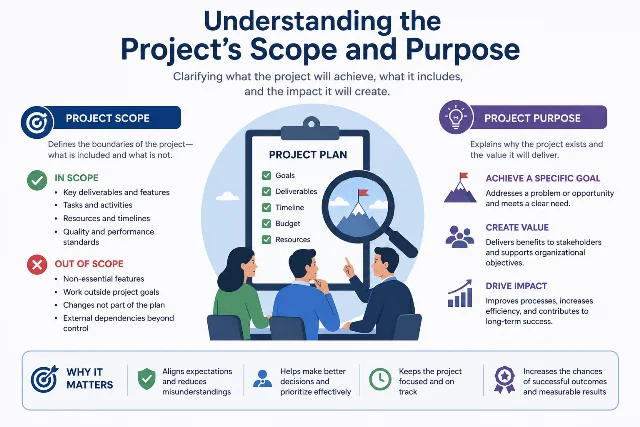
Project scope describes the specific work required to deliver a product, service, or result. It defines what is included and, just as importantly, what is excluded. Project purpose explains why the project exists in the first place. It connects the work to a business need or strategic goal.
Together, these two elements form the backbone of project risk management. A project team cannot assess risk accurately if it does not know what it is building or why it matters. Scope tells the team the “what.” Purpose tells the team the “why.” Risk management depends on both being clear from day one.
Many organizations treat scope and purpose as paperwork exercises. That mindset is a mistake. A well-written scope statement acts as a risk control document. It gives the project sponsor, the project manager, and every team member a reference point whenever a new request or change appears.
In practice, I have sat in change-request meetings where the only thing that settled the debate was pulling up the original scope statement and reading it aloud. That single document ended arguments that could otherwise have dragged on for weeks.
Why Defining Project Scope and Purpose Reduces Risk
Unclear scope is one of the most common sources of project risk. When boundaries are fuzzy, stakeholders assume different things. One department expects a feature. Another expects a report. A third expects neither, but assumes the budget covers both.
This is where scope creep enters the picture. Scope creep happens when small, seemingly harmless additions accumulate over time. Each addition seems reasonable on its own. Together, they can double the workload without any matching increase in budget or time.
A documented purpose statement prevents this drift. It acts as a filter for every new request. If a proposed change does not support the stated purpose, the team has grounds to decline it or escalate it for formal review. This filter is a practical risk mitigation tool, not just a governance formality.
Experienced project managers also use scope statements to manage stakeholder expectations early. Setting expectations early costs far less than correcting them later. A short conversation in week one can prevent a costly dispute in month six.
Key Elements of a Well-Defined Project Scope
A strong scope statement does more than list deliverables. It builds a shared understanding that reduces ambiguity and, therefore, reduces risk.

Clear Deliverables and Boundaries
Every scope statement should list specific deliverables. It should also state exclusions directly. Saying what is not included prevents assumptions from filling the gap. This single practice eliminates a large share of disputes later in the project lifecycle.
Measurable Objectives
Objectives should be measurable, not aspirational. “Improve customer satisfaction” is vague. “Reduce average response time to under two hours” is measurable. Measurable objectives give risk managers a benchmark for tracking performance and flagging deviations early.
Assumptions and Constraints
Every project operates under assumptions: available resources, expected timelines, technology limitations. Documenting these assumptions turns hidden risks into visible ones. A visible risk can be planned for. A hidden risk usually surfaces at the worst possible moment.
Acceptance Criteria
Acceptance criteria define what “done” actually looks like. Without them, project closure becomes subjective. Subjective closure often leads to disputes about payment, quality, or contractual obligations.
Project Scope Example
Reading about scope statements in the abstract only goes so far. Seeing a working example makes the structure easier to apply. Below is a simplified scope example for a mid-sized website migration project.
Project Purpose: Migrate the company website to a new hosting platform to reduce downtime and improve page load speed.
In Scope:
- Transfer all existing pages, images, and metadata to the new host
- Configure redirects for changed URLs to preserve search engine rankings
- Test site performance and load times before go-live
- Train two internal staff members on the new content management system
Out of Scope:
- Redesigning the website’s visual layout or branding
- Adding new features not present on the current site
- Migrating third-party integrations unrelated to hosting
Assumptions: The new hosting provider offers a compatible content management system. Current staff availability allows training within the project timeline.
Acceptance Criteria: The migrated site loads within two seconds on standard connections, all pages return correct status codes, and search rankings show no more than a five percent temporary dip during the transition window.
This kind of example shows why a scope statement works as a risk control document. The out-of-scope section alone would prevent a common request, such as a mid-project redesign, from quietly expanding the budget and timeline.
How Purpose Statements Shape Risk Management Strategy
A purpose statement answers a deeper question than scope alone. It explains the business driver behind the work. This context shapes how a risk manager prioritizes threats.
Consider two projects with identical technical requirements. One exists to meet a regulatory deadline. The other exists to test a new market opportunity. The risk priorities for these two projects differ sharply, even though the deliverables look similar on paper.
The regulatory project treats schedule risk as critical, since missing the deadline may trigger penalties. The market-testing project treats budget risk and reputational risk as more important, since the company can adjust the timeline without legal consequences.
This is why purpose alignment matters so much in enterprise risk management. Risk registers built without a clear purpose statement often misallocate attention. Teams end up managing risks that matter less while ignoring risks that matter more.
Common Scope-Related Risks and How to Control Them
Scope-related risks appear in nearly every industry, from construction to software development. Recognizing common patterns helps teams respond faster.
Scope Creep
Unauthorized or informal changes accumulate over time. Change control processes address this risk directly. Every change request should go through formal review, impact assessment, and sponsor approval before implementation begins.
Scope Gaps
A scope gap occurs when a critical deliverable is missing entirely from the original plan. This risk often surfaces during testing or delivery, when it is expensive to fix. Structured requirements workshops during planning reduce this risk substantially.
Conflicting Stakeholder Expectations
Different stakeholders sometimes hold different mental models of the same project. A shared scope document, reviewed and signed by all key stakeholders, closes this gap before work begins.
Ambiguous Purpose Statements
A purpose statement written in vague corporate language fails to guide decisions. Teams should write purpose statements in plain, specific language that any stakeholder can understand without translation.
Frameworks for Aligning Scope, Purpose, and Risk
Several established frameworks help teams connect scope, purpose, and risk management in a structured way.
ISO 31000 provides principles and guidelines for risk management that apply directly to project scoping. It emphasizes that risk management should be integrated into governance and planning from the start, not added afterward as a separate exercise.
The Project Management Body of Knowledge (PMBOK) treats scope management as one of its core knowledge areas. It outlines processes for planning, defining, validating, and controlling scope throughout the project lifecycle.
Enterprise risk management (ERM) frameworks connect individual project risks to broader organizational objectives. When a project’s purpose statement links clearly to a strategic goal, ERM processes can evaluate that project’s risk exposure in proper context, rather than in isolation.
Using these frameworks together gives project teams a structured, repeatable method for keeping scope and purpose aligned with organizational risk appetite.
Real-World Example: Scope Drift on a Mid-Sized IT Rollout
Consider a mid-sized company rolling out a new customer relationship management system. The original purpose statement described a single goal: consolidate customer data into one platform.
Within two months, several departments requested additional features. Marketing wanted automated campaign tools. Sales wanted a custom reporting dashboard. Support wanted integrated ticketing. None of these requests were unreasonable individually.
Collectively, they tripled the technical workload without any corresponding budget increase. The project missed its original deadline by four months and exceeded its budget by 40 percent.
A post-project review found that the scope statement never defined boundaries clearly enough to reject these requests. The purpose statement was too broad, allowing almost any customer-related feature to seem justified. I have seen this exact pattern repeat across several unrelated organizations, which is what convinced me that vague purpose statements are a genuine, recurring risk factor rather than a one-off failure. This case illustrates why precise scope boundaries matter as much as the purpose statement itself.
Best Practices for Documenting Project Scope and Purpose
Strong documentation practices reduce ambiguity and give risk managers a reliable reference point throughout the project.
Write in plain language. Avoid jargon that different stakeholders may interpret differently. Clarity prevents costly misunderstandings later.
Involve stakeholders early. A scope statement drafted in isolation rarely reflects everyone’s actual expectations. Early collaboration surfaces conflicting assumptions before they become disputes.
Review scope regularly. Projects evolve. Scheduled scope reviews, rather than reactive ones, keep the document aligned with current realities without inviting uncontrolled changes.
Tie scope to purpose explicitly. Every deliverable should trace back to the stated purpose. If it does not, question whether it belongs in the project at all.
Document change history. Keeping a record of approved changes, along with their justification, helps future audits and risk reviews understand how the project evolved.
Conclusion
Clear project scope and purpose form the backbone of sound risk management. They define boundaries, guide decisions, and give teams a shared reference point when new requests appear. Projects that skip this foundational work often face scope creep, budget overruns, and stakeholder conflict. Frameworks like ISO 31000 and PMBOK offer structured ways to keep scope and purpose aligned with broader risk priorities. Teams that invest time upfront in defining both consistently deliver more predictable outcomes. Start every project by writing scope and purpose statements that are specific, measurable, and shared with every stakeholder involved.
Frequently Asked Questions
What is the difference between project scope and project purpose? Project scope defines the specific work, deliverables, and boundaries of a project. Project purpose explains the underlying reason the project exists, usually tied to a business need or strategic goal.
Why does unclear project scope increase risk? Unclear scope allows stakeholders to hold different assumptions about deliverables. This gap often leads to scope creep, budget overruns, and disputes during project closure.
How does scope creep happen if the project has a defined scope? Scope creep usually happens through informal, unapproved changes that accumulate gradually. Without a formal change control process, small additions can significantly expand the workload over time.
What frameworks help manage scope-related project risk? ISO 31000 provides general risk management principles, while PMBOK offers detailed scope management processes. Enterprise risk management frameworks connect project-level risks to broader organizational objectives.
Can a project have a clear scope but a weak purpose statement? Yes. A project can list clear deliverables while still lacking a specific purpose. This weakens decision-making, since teams cannot judge whether new requests support the original business need.
How often should a project team review its scope statement? Review frequency depends on project size and complexity, but most teams benefit from scheduled reviews at each major milestone rather than only when problems arise.
Who should be involved in writing the scope and purpose statements? Key stakeholders, the project sponsor, and the project manager should all contribute. Early involvement reduces the chance of conflicting expectations appearing later in the project.

