
Projects in the private sector have real financial implications. When a deadline is missed or the budget is exceeded, it can damage a company’s reputation. In private sector projects, risk management can assist teams to foresee issues before they get too out of hand. The guide unpacks practical approaches, frameworks and tools that those with expertise in this field use daily.
Project uncertainty is a fact of life in every industry. A software company is concerned about scope creep and integration issues. A manufacturer is concerned about the scarcity of raw materials and equipment availability. The field of risk management remains the same across industries, despite the differences.
We will go through the complete risk management lifecycle in this article. Readers will be taught to recognize threats, understand their seriousness and react confidently and appropriately. The aim is to give real practice rather than a theory that is removed from the work of the project.
What Is Risk Management in Private Sector Projects?
Risk Management is the systematic handling of threats to a project, risk identification, risk assessment, and risk control. Projects in the private sector may have a smaller margin of error than projects in the public sector. Firms need to take into account the trade-off between profitability and timeliness. An effective project risk management approach is able to safeguard both objectives.
It’s not like private companies have infinite budgets and time limits. Each of these delays is a monetary loss on the bottom line. Therefore, risk evaluation is a fundamental part of business practice, rather than an optional. Teams that bypass this step find themselves with issues that they are unable to resolve economically.
Good risk management also fosters investor and client confidence. Stakeholders are demanding evidence of a company’s exposure. Evidence of risk mitigation strategies demonstrates maturity and operational discipline. This trust can translate to improved partnerships and repeat business.
It also aids in the distinction between risk management and straightforward problem solving. Problem solving is a response to mistakes or failures. Risk management takes place in advance, decreasing the probability of issues happening at all. A forward-looking attitude is a key difference between the mature project organization and the reactive project organization.
These days, risk management has become a competitive advantage for many private companies and not just a compliance measure. Customers are increasingly wanting to see risk processes before signing contracts with vendors. When you have a documented approach, it can make a difference in securing new business.
Why Private Sector Projects Need Structured Risk Management
Private projects are financed by private investors whose interest rates and expectations must be satisfied, as opposed to government projects where such interest rates and expectations are not necessarily met. There are immediate financial consequences for failure. One uncontrolled risk can ruin a whole quarter’s profits. This is a reality, and the formal risk management framework must be adopted.
There’s the pressure of competition. Private businesses compete for business, market share, and talent. The failure of a project in publicly can hurt a brand for years. Good risk management is as much about reputation as it is about profits.
There has been increased regulatory interest in numerous industries. There are compliance requirements for construction, finance, health and tech. Failure to consider legal and regulatory risks can result in fines or termination of contract. Compliance is visible throughout the project life cycle with structured risk management.
Last but not least, private sector groups frequently collaborate with outside contractors and vendors. New relationships bring new stakeholder risk management issues. When there is no process, accountability gaps are identified within a short period. A defined framework fills those gaps in the beginning and prevents disputes.
When major industry failures occur, investors will also give careful consideration to project risk. In the past decades, due diligence has been far more stringent with high-profile failures. Firms with no apparent risk practices might not be able to raise any capital at all.
Formal risk management is becoming a growing requirement for insurance underwriters to obtain before providing coverage. Premiums can be lowered and a documented process can create greater coverage options. In fact, this incentive is a financial one and motivates companies to formalize their approach in a more practical way.
Key Types of Risks in Private Sector Projects
There are various types of risks in Private Sector Projects. Each type of disaster requires its own approach to recovery, and knowing each type will help teams develop focused plans rather than sweeping plans that are ineffective.
Financial Risks
Budget overruns continue to be the biggest risk to private projects. The decision-making process of financial risk management is influenced by currency fluctuations, changes in interest rates and cost inflation. Continuous monitoring of the actual spending in relation to the forecast is required, not just monthly.
Positive cash flow can be the death knell for even a profitable project. A client may not pay a contractor on time, causing their wages to be delayed. This exposure is lowered with financial buffers in contracts. If you’re an experienced project manager, you’ll know that you need to reserve 10 to 15 percent of your project budget as a contingency reserve.
There is also risk involved in financing structure with larger private ventures. Debt projects are under pressure to be paid back even if they do not go ahead. If the interest rates suddenly spike up, the project may become profitable or unprofitable in an instant. Discussing financing terms early will assist teams to prepare for these scenarios.
Operational Risks Management
Operational risks are issues that come up while operations are running. Equipment malfunction, lack of workers and delays in the supply chain are examples of this category. There is a need for close coordination between procurement, logistics and site teams for operational risk management.
Human error is a significant factor in operational risk. There is rework that happens because of miscommunication between departments and the hours are wasted. These unnecessary errors can be minimized with clear documentation and regular check-ins. But standardized workflows also assist new team members in faster onboarding.
Reliability of vendors is a particular issue in operational planning. One bad supplier can throw a spanner in the works of a good schedule. Having more than one vetted vendor helps significantly mitigate the single point of failure problem.
Legal and Regulatory Risks
All private sector projects are defined by contracts, permits and industry regulation. Failure to comply with an application deadline may result in an end to construction work altogether. Further complexity is added by companies with international operations.
Consequences of non-compliance are severe and public. One breach could result in a system-wide audit. It is never too early for legal counsel to review contracts—it’s always when there are disputes. This is an advantage ahead of time, avoiding expensive renegotiations later on.
In the cases of technology and product development projects, intellectual property disputes are also included. It’s easy for the ownership specifications to get confused in early contracts and become costly disputes down the road. This is a pitfall to avoid by clear definition of IP ownership at project start-up.
Market and Competitive Risks
Private sector conditions change more quickly than do public sector conditions. The appearance of a competitor’s product can totally alter customer expectations in a matter of seconds. Projects with market timing requirements have an additional pressure to meet on time.
There is also risk in the form of inaccuracies in demand forecasting. Underestimating market appetite wastes resources with items not being sold and/or not being used. Continual market research ensures that assumptions are based on real data, rather than out-of-date predictions.
Competition may also drive down prices, thereby destroying the business case of a project. If market prices decrease, a project that has been approved at one margin assumption could be unprofitable. A regular review of the business case helps to maintain realistic financial expectations.
Technology and Cybersecurity Risks
Digital systems are crucial to modern private sector projects. Progress can be stalled at a moment’s notice due to software failures, data breaches, and integration errors. Technology infrastructure is now a key element of the risk assessment process.
Threats on the cyber front are becoming more complex these days. One exposure could be the death of your client data and result in legal liability. Security investments result in lower costs if the investment happens at an early stage as compared to a post incident recovery.
There is also technology risk due to third party software dependencies. When a vendor goes down or stops supplying a product, it could cause a project to come to a standstill. This is one of the most overlooked exposures that is minimized when the vendor’s stability is assessed prior to adoption.
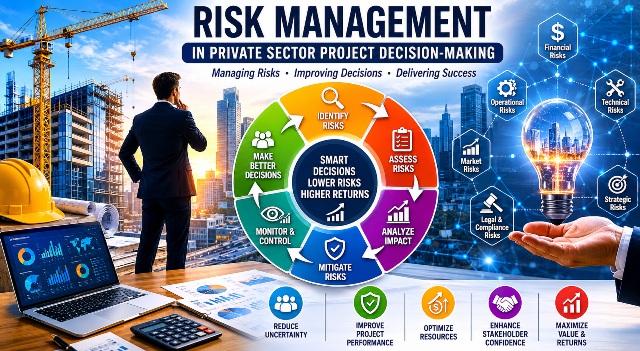
Core Steps in the Risk Management Process
A repeatable process transforms risk management from an art into science. There are basic steps that must be taken by most successful private sector teams.
Risk Identification
The identification process begins with the collection of information from all the stakeholders of the project. The risk aspects are different for site managers, financial teams and clients. Brainstorming sessions can uncover patterns, as can data from past projects.
Team use of checklists reduces the risk of missing out on common areas. Industry-specific templates can help accelerate this process significantly. Teams should adapt checklists for each specific project context, however.
When you have an interview with the experienced members of the team, you can find out a lot of risks that will not be found in the documents. If there has been a similar project in the past, someone who has done the project might remember a particular supplier issue. This is institutional learning that allows teams to avoid unnecessary errors.
Risk Assessment and Analysis
The risks have to be evaluated for likelihood and impact once they are identified. For most teams, the simple probability-impact matrix is satisfactory. This visual tool helps to categorize risks from low to critical risks.
For high-stakes projects, quantitative analysis provides a level of precision. Sensitivity analysis or Monte Carlo simulation can be used to estimate financial exposure. For smaller projects, qualitative scoring may be sufficient to help make decisions.
The scoring method is as important as consistency! All team members should use the same risk criteria to rate risks. When everyone’s understandings of high and low impact are aligned, it’s a calibration session.
Risk Response Planning
Once the risk is assessed, a response strategy is selected for each risk. This can be achieved through avoidance, mitigation, transfer and acceptance. Risk mitigation measures should be commensurate to the level of risk and its probability.
Insurance and subcontracting is effective against certain threats. Avoidance could be the complete changing of the project scope. Where the cost of responding to risk is greater than the potential damage, acceptance suits the low impact risk.
There should also be a contingency plan in case of a response. Even with a good plan, things can go wrong. A secondary response includes documentation that prepares teams for the future if a secondary response should occur.
Risk Monitoring and Control
The plan is not the only part of the risk management process. Risk monitoring and control is an ongoing process during the project life. Ongoing status reviews identify potential redeveloping risks early on.
Distributed teams can monitor with ease using dashboards and reporting tools. Assigning the risk owners will provide accountability at each stage. Even if risks are well documented, they go unaddressed unless someone owns them.
As well as tracking risks that are active, it is just as important to close out risks that have been resolved. Risk registers with numerous and dated entries become useless very soon. Closed risks are kept in the archive, which allows for an easier review of the active list.
Risk Management Frameworks for Private Sector Projects
Having established frameworks provides teams with a proven structure they can follow. Following a recognized standard also enhances the project governance credibility with investors and auditors.
ISO 31000 Framework
ISO 31000 offers risk management principles worldwide. It focuses on embedding risk thinking in all decisions made by an organization. This framework can be applied to any industry, ranging from construction to financial services.
The standard is based on continual improvement instead of compliance. This requires a periodic review of teams’ risk processes. Numerous private companies are implementing ISO 31000 in order to be compliant with their international clients and partners.
ISO 31000 is a principle based standard, not prescriptive, so is easily adapted to various company sizes. A small company can implement its core concepts without a large overhead in documentation requirements. More detailed procedures can be added to the same principles in larger organisations.
PMI Risk Management Framework
The Project Management Institute has an extensive risk framework provided in its PMBOK guide. It splits the process of risk management into planning, identification, analysis, response and monitoring steps. This is a structure that easily accommodates existing work flows of project risk management.
PMI’s method is appropriate for teams that are already using PMBOK methodology in other projects. It integrates well with scheduling, budgeting and quality management processes. Certification programmes also contribute to the development of team internal capacity.
PMI’s framework is widely recognised in the industry, which can be beneficial for the team that adopts it. There is a faster review time of project plans for clients with PMBOK knowledge. This common language helps to speed up the process of onboarding new project partners.
COSO ERM Framework
The COSO Enterprise Risk Management (ERM) framework integrates project risk into the overall business strategy. It fosters the mindset of risk as a strategic asset, not threat. This view allows private companies to make decisions that fit with the big picture.
COSO is useful for organizations that are working on several projects at the same time. Establishes a common risk vocabulary between departments and portfolios. This uniformity helps to eliminate confusion when risks cross multiple business units.
Executive teams are generally more receptive to COSO, as it directly connects to governance and reporting requirements. Board members can take a look at an enterprise-wide exposure to risk through consistent categories. This visibility aids in the strategic decision making process at the highest level.
Best Practices for Managing Project Risks
Consistent practices are more important than documentation for strong risk management. The following practices help to differentiate the resilient project from the vulnerable project.
Begin to plan risk early in the proposal process, not at kickoff. Teams have more response options and reduced costs with early identification. The delay until execution makes things inflexible and also brings about the price of corrections.
Designate a point of responsibility for each identified risk situation. Without an owner, there’s a risk that doesn’t get the attention it deserves. Ownership engenders accountability and hastens the responses.
Clearly and effectively convey risk to all stakeholders. Don’t hide problems from clients or investors or you lose their trust easily. Even bad news is good news if it is reported honestly, which may mean that it is presented in a way that is far from ideal.
Keep risk registers updated on a regular basis, not just at key milestones. Projects are dynamic and static registers are easily out-of-date. Information and actions are kept current with weekly or bi-weekly reviews.
Include contingency reserves in budget and schedule. Even in a well-designed project, the unexpected happens and delays occur. A realistic buffer minimizes small problems to large problems.
Educate teams about the basics of risk assessment, not only senior executives. Operational risks frequently are first identified by frontline personnel. Their ability to report problems is a great boost to early detection.
Reflect on learning from all projects, good or bad. The past is a great source of risk management information. Failure to do so is repetition of errors for future work.
Common Challenges in Private Sector Risk Management
Even the strongest frameworks have implementation challenges when put in practice in real-world conditions. Identifying these challenges allows teams to make better plans to address them.
In many cases, risk analysis by small companies is inadequate because of limited resources. Some larger companies might employ risk departments. SMBs can mitigate this by prioritizing their most critical threats first.
Scepticism of change also retards the formal processes. Teams that are used to informal approaches may find documentation to be a burden. If you can show early success, it will help gain buy-in throughout the organization.
Even the most advanced risk models can be negatively affected by data quality problems. Unfortunately, the history is not well documented and it is difficult to make probability estimates. Investing in improving data collection leads to more accurate risk analysis future.
Departments communicate with each other in silos, leading to blind spots. Operational risks could be unknown to Finance. Cross-functional risk reviews address these information gaps well.
Teams can also be forced to abandon the risk review process completely under time pressure. Often, planning steps become dispensable when deadlines are tight. It is important for leaders to ensure there is time for risk discussions even when it seems like it is not needed.
Tools and Techniques for Effective Risk Management
Today’s tools are more efficient and precise than the manual options. The combination is determined by the project’s size and complexity.
The basis of most programs still remains risk registers. These living documents document identified risks, owners and response plans. Smaller projects can be managed with a spreadsheet-based register, larger portfolios can be handled by enterprise software.
Teams can prioritize visually using probability-impact matrices. This straightforward matrix combines the degree of risk with the probability of the risk. Teams can easily prioritize on the most vital threats.
In SWOT analysis, risk is identified with other factors of strategy. This technique is used to relate project threats to organizational strengths and weaknesses. It is effective at the initial planning phase particularly.
Root cause analysis techniques, such as the 5 Why’s, help to identify the root cause of the problem. Symptoms at the surface may be clues to more serious issues. Root causes eliminate reoccurring risk events in future projects.
There are now real-time dashboards and automated alerts in dedicated risk management software. These systems connect directly with scheduling and budgeting software. By eliminating the need to manually track, automation minimizes the amount of time management needs to spend and the likelihood of manual tracking errors.
Teams can use scenario planning to prepare for several different futures simultaneously. Rather than forecasting one outcome, teams create models of both the best and worst case scenarios as well as the most likely. This is to increase flexibility in decision making in the face of actual uncertainty.
Real-World Example: Risk Management in Action
Imagine a medium-sized construction company is constructing a commercial office building. The steel material was identified as a potential risk in the supply chain through early risk assessment. The project team arranged for a standby supplier prior to construction.
A few months later, the primary supplier ran out of stock and the alternate contract went into effect. The project went ahead without a problem and remained on time. This is an example of what proactive planning can achieve to avoid unnecessary downtime.
The same company also detected currency risk for imported machines. A forward contract is an agreement that fixed the exchange rates, which saved the budget. If not, a currency change might have caused extra unforeseen expenses.
Another example is a private technology company bringing a new product to market. The team found cybersecurity risk in the design process, pre-launch. They started to invest in penetration testing and secure code review early in the development.
When a routine security audit discovered its vulnerability, this early investment came back to reward. The team spent time on fixing and fixed it before it is released. If the discovery had been made late, the launch might have been delayed for the month or more.
The following examples illustrate how effective structured risk mitigation strategies can provide real returns. Being proactive is much cheaper than being reactive. The companies that invest in risk management routinely beat those that don’t.
Building a Risk-Aware Project Culture
It’s not only documents that count for culture that will lead to long-term success. There is a need for transparency in risk communication from the top down. Senior management sets a good example and this is followed by teams.
Reward staff who detect hazards before it is too late, not necessarily save the day. This reinforcement helps to promote proactive reporting all throughout. When bad news isn’t met with punishment, then it is less likely that honest communication will occur in future projects.
Discuss risk at routine team meetings, rather than annual reviews. Risk awareness is maintained through conversation, throughout operations. This habit helps avoid that risks are not lost in between the formal review cycles.
Keep investing in continuous education to keep up with the changes in industry and technology. Yesterday’s risk priorities might not be applicable to tomorrow’s challenges. Teams are always ready for new threats with continuous learning.
Inter-departmental risk workshops also facilitate culture development in the long run. Finance, Operations, Legal – together create common ground. Often these sessions uncover aspects of risks that are not captured by one department individually.
Lastly, acknowledge and reward projects that are done on time and on budget due to effective risk management. Emphasizing these victories helps to underscore the importance of the process. It transforms risk management into a proven success driver.
Roles and Responsibilities in Risk Management
Clear roles ensure you don’t have risk management as everyone’s job and nobody’s priority. In most projects undertaken in the private sector, there is a clear delineation of the ownership of the risks. If it isn’t there, the accountability void becomes apparent at a very early stage when implementing.
In general, the project sponsor is the one who has the final say on major risk decisions. This person approves large contingency spending and strategic response choices. Their participation indicates that risk management is a top priority issue.
The project manager typically oversees the on-going work of the risk activities. This involves keeping the risk register up to date and holding regular review meetings. They serve as the hub of all the risk-related information.
Each team member is a risk owner for certain items in their competency. Procurement lead can be responsible for supply chain risks. A finance lead may instead be responsible for risks to budget and currency.
Other external advisers who are not directly involved in the initial launch, such as legal representatives and insurance brokers, are also involved in the project in a supporting role. They have niche skills that enable teams to deal with risks that are not in their main skill set. It is much better to have them in early than later when issues arise.
Measuring the Return on Risk Management Investment
Establishing formal risk processes is challenging for many private companies, as they are not always convinced about the added value. Measuring ROI helps convince leadership of the value of this investment. There are a number of practical measures that do this well.
One direct measurement approach to tracking avoided costs is to measure the economic costs of the avoided services. Once a team has discovered a risk and successfully eliminated it, the prevented cost can be quantified. If this is compared to the risk management program cost, then there is a clear value.
Another helpful measure is adherence to the schedule. Projects that have robust risk management will tend to encounter fewer unforeseen delays. Findings are reflected in a significant difference in delaying time before and after the process is formalized.
The quality of risk management is also indirectly measured by client satisfaction scores. Projects which don’t cause too much disruption are more likely to get positive feedback. This relationship demonstrates the business rationale for further investment in risk practices.
The longer term signal is also insurer premium trends. Some businesses may be eligible for reduced premiums if they have a well-documented risk management program. Structured processes are a sign of lower exposure risk for insurers.
These are not all metrics to consider alone. The benefits of using multiple measurements is that leadership has a more balanced view. This is a well-rounded approach rather than exaggerating the results, but proving genuine value.
Conclusion
Private sector projects are protected by effective risk management that safeguards the budget, schedule, and reputation. Teams catch potential threats early and use a sound framework such as ISO 31000 to minimize unpleasant surprises. Good risk mitigation measures, ownership, and monitoring makes uncertainty actionable. Companies that create a “risk-aware culture” consistently achieve better results than companies that only respond when issues arise. Begin assessing your existing project risks now, and develop the habit of safeguarding your next big project.
Frequently Asked Questions
Q. What is risk management in private sector projects?
Identifying, evaluating and managing risks to a project’s budget, schedule or result. It is utilized by private companies to keep their profitability and client trust during delivery.
Q. Why is risk management more critical in private sector projects than public ones?
In private companies, the consequences of failure are immediate and financial; it is the shareholders and the clients to whom the private company is accountable. Competition and smaller margins early in the game spell survival.
Q. What are the most common risks in private sector projects?
The most common risks are financial, operational, legal, market, and technology risks. Depending on the industry and scope of the project, the assessment and the response to each category may be different.
Q. Which risk management framework works best for small businesses?
ISO 31000 is flexible and scalable and works for most small businesses. Instead, PMI or COSO frameworks may be more suitable for larger firms that are dealing with multiple projects.
Q. How often should a project risk register be updated?
Active projects receive weekly or biweekly updates. Only static registers that are reviewed at milestones may not be able to catch risks that arise between the milestones.
Q. Can small companies afford formal risk management processes?
Yes, but they should definitely work on their most serious risks first! Decision making is greatly enhanced at little cost by simple spreadsheet registers and probability-impact matrices.
Q. What is the difference between risk mitigation and risk transfer?
Mitigation – Minimizes the likelihood or impact of a risk directly, usually by changing the process. Delegate responsibility to another party, e.g. via insurance or subcontractors.
Q. How does risk management improve stakeholder trust?
Clearly communicating risks demonstrates to investors and clients that a business manages risks. Documented processes and honest reporting creates confidence even when there are issues during a project.

