

If you’re studying how risk management shapes decision-making in construction, IT, or finance projects — or writing a dissertation methodology chapter on a similar topic — this guide walks through the full research design process: from choosing a research philosophy to running a systematic literature review using PRISMA guidelines. It combines the theory with practical, step-by-step guidance you can actually apply.
What Is the Research Onion Framework?
The Research Onion is a model developed by Saunders, Lewis, and Thornhill (2023) to help researchers plan a study layer by layer, working from broad philosophical assumptions down to specific data collection techniques. Picture it literally as an onion: each layer you peel back gets more specific.
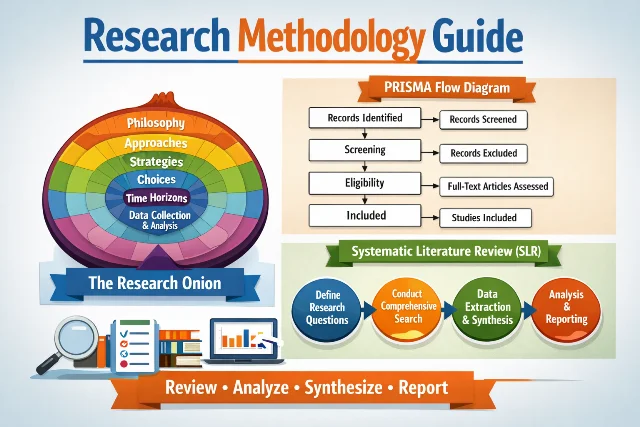
The layers, from outside to inside, are:
- Research philosophy — your underlying assumptions about how knowledge is created (e.g., positivism vs. interpretivism)
- Research approach — how you develop theory (inductive, deductive, or abductive)
- Methodological choice — whether you use qualitative, quantitative, or mixed methods
- Research strategy — the overall plan (e.g., case study, survey, systematic literature review)
- Time horizon — whether the study is a single snapshot (cross-sectional) or tracks change over time (longitudinal)
- Techniques and procedures — the actual data collection and analysis methods used
Why does this matter in practice? Because each layer constrains the next one. If you choose an interpretivist philosophy, a systematic literature review of qualitative studies makes more sense than, say, running a statistical regression. The Research Onion forces you to make these choices consciously and consistently, instead of picking methods that don’t logically fit together — which is one of the most common weaknesses examiners flag in dissertation methodology chapters.
Why Choose an Interpretivist Philosophy?
Choosing a research philosophy comes down to one question: what kind of question are you actually trying to answer?
Positivism treats reality as objective and measurable — you’re looking for facts, patterns, and statistically testable relationships. It’s the right fit when your question is something like “does adopting ERM reduce cost overruns by a measurable percentage?”
Interpretivism treats reality as shaped by human perception and context — you’re trying to understand how people interpret and act within a situation. It’s the right fit when your question is more like “how do project managers actually use risk management frameworks when making decisions under pressure?”

For a study on how risk management frameworks like ERM and RAROC get applied in construction, IT, and finance decision-making, interpretivism tends to be the better fit. Here’s why: these frameworks often look uniform on paper but get applied inconsistently in practice. A site manager might weigh a documented safety risk against client pressure to hit a deadline. A portfolio manager might formally follow RAROC guidance while relying on judgment calls the model wasn’t designed to handle. Capturing that gap between “framework as designed” and “framework as actually used” requires a philosophy built around interpretation and context — not just measurable outcomes.
Quick way to decide: if your research question starts with “how much” or “how many,” lean positivist. If it starts with “how” or “why do people,” lean interpretivist.
Research Approach: Inductive vs. Deductive
Once you’ve picked a philosophy, you need to decide how you’ll develop theory:
- Deductive research starts with an existing theory or hypothesis and tests it against data. Example: “ERM adoption reduces decision-making delays — let’s test that against project data.”
- Inductive research starts with observations and builds theory from patterns that emerge. Example: “Let’s review the existing literature on ERM and RAROC use in construction, IT, and finance, and see what patterns emerge about how — and whether — these frameworks actually shape decisions.”
An inductive approach fits a systematic literature review well, because you’re not testing one fixed hypothesis — you’re synthesizing findings across many studies to see what patterns, contradictions, and gaps show up. This is especially useful when a topic (like framework adoption across different sectors) is likely to show inconsistent findings rather than one clean answer.
How to Conduct a Systematic Literature Review (Step by Step)
A systematic literature review (SLR) isn’t just “reading a lot of papers” — it follows a defined, repeatable process. Here’s the general sequence, based on PRISMA guidelines (Page et al., 2021):
Step 1: Define your research question clearly.
Be specific. “How is risk management used in business?” is too broad. “How are ERM and RAROC frameworks applied in project decision-making in construction, IT, and finance?” is workable.
Step 2: Set your inclusion and exclusion criteria before searching.
Decide upfront what counts as relevant (e.g., peer-reviewed, published within a specific date range, specific sectors) and what doesn’t. Setting this before you search — not after — is what keeps an SLR from becoming cherry-picked evidence for a conclusion you already wanted.
Step 3: Choose your databases.
Academic databases like Google Scholar and Scopus are standard starting points because they index peer-reviewed, credible sources.
Step 4: Build your search strategy using Boolean operators.
Combine keywords with AND, OR, and NOT to narrow results precisely (see the example below).
Step 5: Screen results against your criteria.
Run the search, then filter out anything that doesn’t meet your inclusion criteria — usually done first by title/abstract, then by full text for anything that passes the first filter.
Step 6: Extract data systematically.
For every included study, log the same fields (author, year, framework discussed, sector, key finding) so you can compare across studies consistently.
Step 7: Synthesize findings.
Group studies by theme, compare where they agree or disagree, and identify gaps the existing literature hasn’t addressed.

Example of a PRISMA Search Strategy
Here’s a concrete example of how Boolean search terms might be structured for this type of study:
| Search Goal | Example Boolean Query |
|---|---|
| Find studies on ERM in construction decision-making | “Enterprise Risk Management” AND “decision-making” AND “construction” |
| Find studies on RAROC in IT projects | “Risk-Adjusted Return on Capital” OR “RAROC” AND “IT” |
| Exclude unrelated sectors | “Risk management frameworks” NOT “healthcare” |
| Narrow to a date range | Apply database date filters for 2018–2025 |
A good search strategy usually runs multiple variations of these queries across each database, since different phrasing surfaces different results — searching only “ERM” without also trying “Enterprise Risk Management” as a full phrase can miss relevant studies.
Sample Data Extraction Table
Once studies pass your inclusion criteria, extracting data into a consistent table makes comparison much easier. Here’s a simplified example of what that table might look like:
| Study | Sector | Framework Discussed | Project Stage | Key Finding |
|---|---|---|---|---|
| Example Study A | Construction | ERM | Planning | Framework formally adopted but overridden under schedule pressure |
| Example Study B | Finance | RAROC | Execution | Model followed closely for standard cases, judgment used for edge cases |
| Example Study C | IT | ISO 31000 | Initiation | Framework used mainly for compliance documentation, less for actual decisions |
(Note: these are illustrative examples of table structure, not real study citations. When building your own table, every row should reference a real, verifiable source from your search results.)
Common Mistakes in SLR Research
A few mistakes come up repeatedly in systematic literature reviews, especially in dissertation work:
- Setting inclusion/exclusion criteria after searching, not before. This lets bias creep in — you end up keeping studies that support your expected conclusion.
- Relying on a single database. Google Scholar alone will miss studies indexed elsewhere; using at least two databases (e.g., Scopus and Google Scholar) reduces this gap.
- Citing sources without a matching reference list. Every in-text citation needs a full, verifiable reference — unreferenced citations undermine the credibility of the whole review.
- Inconsistent date ranges. If your methodology says you searched 2018–2025, every table and criteria section needs to match that exactly — internal contradictions are one of the most common and easily avoidable errors in this type of writing.
- Describing the review process without actually synthesizing findings. An SLR isn’t just a list of what was searched — the real value is in comparing findings across studies and identifying patterns or contradictions.
- Overusing secondary sources that summarize other summaries. Where possible, go back to the original study rather than citing a source that’s already several steps removed from the original data.
Data Analysis Approach
Once data is extracted, synthesis typically happens in three stages:
Descriptive synthesis — summarizing what each included study found, grouped by shared themes (e.g., how ERM is applied at each project stage).
Comparative analysis — comparing findings across frameworks (ERM vs. RAROC vs. ISO 31000) and across sectors, to see where practice is consistent and where it diverges.
Identifying gaps and contradictions — flagging where studies disagree, rather than smoothing over inconsistencies. If one study describes a framework as central to decision-making and another describes it as a compliance formality, that contradiction itself is a useful finding — it points to where future research is needed.
Research Limitations
Studies based on secondary literature carry some built-in constraints worth stating plainly:
- Literature published after the search cutoff date won’t be captured, so very recent developments may be missing.
- Findings from a limited set of sectors (e.g., construction, IT, finance) shouldn’t be generalized to sectors with different risk profiles.
- Peer-reviewed journals tend to favor novel or positive findings, so studies with negative or inconclusive results about framework effectiveness may be underrepresented — a general limitation of literature-based research (Page et al., 2021).
Ethical Considerations
Because this type of research relies on secondary sources, the core ethical obligations are:
- Accurate citation — every source referenced properly, both to credit original authors and let readers verify findings themselves
- Consistent application of criteria — inclusion/exclusion rules applied the same way to every study, not selectively
- Transparency about limitations — being upfront about what the review does and doesn’t cover, rather than overstating its scope
Frequently Asked Questions
What’s the difference between a systematic literature review and a regular literature review?
A systematic literature review follows a defined, documented process (like PRISMA) with explicit inclusion and exclusion criteria set before searching. A regular literature review is more informal and doesn’t require the same level of methodological transparency.
Do I need primary data if I’m doing a systematic literature review?
No — an SLR is specifically a secondary-data method. It’s a valid, standalone methodology when your goal is to synthesize existing research rather than generate new data.
How many databases should I search for an SLR?
At least two is standard practice (commonly Google Scholar plus a specialized database like Scopus or Web of Science), since relying on one database risks missing relevant studies.
Can I mix inductive and deductive approaches?
Yes — this is called an abductive approach, and it’s common in practice. But if you’re mixing approaches, your methodology chapter should say so explicitly and explain why, rather than describing the study as purely inductive or deductive when it’s actually both.
What’s a reasonable date range for a literature search?
It depends on how fast the field is moving. For fast-changing topics, a 5–7 year window is common. For more established theory, a wider window may be appropriate. Whatever you choose, apply it consistently across your entire methodology.
Key Takeaways
- The Research Onion (Saunders et al., 2023) helps structure methodology decisions layer by layer, from philosophy down to specific techniques.
- Interpretivism fits research questions about how people use frameworks in practice; positivism fits questions about measurable outcomes.
- A systematic literature review requires criteria set before searching, not after — this is what keeps it systematic rather than selective.
- PRISMA guidelines (Page et al., 2021) provide a transparent, standard structure for search strategy, screening, and reporting.
- The most common — and most avoidable — mistakes in SLR work are internal inconsistencies (like mismatched date ranges) and citations without a matching reference list.
References
Saunders, M. N. K., Lewis, P., & Thornhill, A. (2023). Research Methods for Business Students (9th ed.). Pearson.
Page, M. J., McKenzie, J. E., Bossuyt, P. M., Boutron, I., Hoffmann, T. C., Mulrow, C. D., et al. (2021). The PRISMA 2020 statement: an updated guideline for reporting systematic reviews. Systematic Reviews, 10(1), 89.
Committee of Sponsoring Organizations of the Treadway Commission (COSO). (2017). Enterprise Risk Management — Integrating with Strategy and Performance.

 methods with practical examples)