

Why Understanding Business Risk Matters
Uncertainty abounds in the world of commerce, no matter how large or small a business might be, or what type of business it is. In one moment, a company is flourishing with great revenues and customers who are loyal to the business. Its survival is now endangered by the next unexpected market change, failure to operate or a change in regulation.
This is not downbeat; it’s what it says. Smart companies don’t fear risk, they face it head on, anticipate it and plan for it.
Even if you are a new business with little capital or a senior executive at a Fortune 500 company, the skill of identifying and controlling various business risks is the key to a successful organization. Industry studies show that companies with formal risk management have fewer losses, better financial results and are more resilient in downturns.
This guide will cover the 7 basic categories of business risks that impact organizations, how to discover them, and helpful recommendations for effective management.
What Is Business Risk? Foundational Concepts
Outline The Definition And Core Characteristics
Business risk is the possibility or uncertainty that may negatively affect the performance, profitability or continuity of your business. Business risk is risk that can lead to loss or gain, as opposed to pure risk (which can only lead to a loss).
Risk is a part and parcel of business. The key is knowing what risks are important to your organization, and what you will do about them.
Business risk can be characterized by the following:
Why Businesses Must Identify And Manage Risk
Risk management is a necessary element; not a luxury. The organizations that take steps ahead take advantage of:
The Repercussions Of Bad Risk Management
This is also true in reverse. Not addressing and mismanaging risk can lead to:
The 7 Essential Types Of Business Risk
Risk may be expressed in various ways in a different industry or company but most organizational risks can be grouped into seven main categories. Knowledge of both is important to form a breadth of risk management strategy.
1. Financial Risk: When Money Matters Most
The most apparent and quantifiable form of business risk is financial risk. It’s anything that affects the financial health, cash flow or profitability of your business.
Types Of Financial Risk
The risk that the customer or partner will be unable to fulfill their obligations. In a manufacturing company, credit risk comes in when the retailer goes bankrupt while it extends credit to the retailer.
Currency Risk: Businesses that are active in the international scene, may face a lot of effects on profit if exchange rate changes. If currency rates fluctuate against a U.S. exporter, he or she will experience currency risk.
Interest Rate Risk: Risk to businesses when they have debts. Rising rates by the Fed will make borrowing less profitable for you.
Liquidity Risk: This is the risk of not being able to access cash when required. But if a business has a lot of assets but they can’t be quickly converted to cash, it can be in serious trouble.
Leverage Risk: too much debt financing increases responsibilities in a downturn. Even if revenue decreases, the company has to satisfy the debt.
Real-World Example
For a retail store chain that takes on too much debt to expand. During a slowdown, the decline in consumption leads to a sharp decline in revenue, while debt payments continue at the same level. If the company has no credit facilities or proper reserve of cash flow, it’s in financial distress.
How To Assess Financial Risk
Track and evaluate these important financial ratios: cash flow, debt-to-equity ratios, interest coverage ratios, working capital. Run periodic stress tests to understand how your business would fare in bad times (30% less revenue, 2% interest rates, etc.).
2. Operational Risk: Internal Process Failures
Operating risk is caused by shortcomings or failures in internal procedures, individuals, systems, technology or processes. It’s about the challenges you face in your everyday operation of your business.
What Are Some Common Operational Risk Scenarios?
The Effect On Business Continuity
Operational disruptions can cause an overnight halt in revenue generation. When a software company’s data center goes down, there is no service for the customers. Restaurants having a kitchen fire bring their operations to a standstill. They aren’t theoretical risks, they are operational reality risks that impact thousands of businesses each year.
Mitigation Strategies
3. Strategic Risk: Missing The Market Opportunity
A strategic risk occurs when a firm’s strategy is not in line with the market, the competition, or the needs of the customers. It is the danger of taking bad decisions in business.
The Impact Of Strategic Miscalculations And Other Factors
A firm launches a new product on a market where it is not yet established, spending a lot on R&D and marketing activities. The company is going to see a huge loss as well as market position if the market doesn’t take the product.
For instance: Company is not innovative and the competitors make better products. The customer base declines as people find other companies that can provide them with more effective solutions.
Industry Examples
However, although Kodak invented digital photography, they were not ready to accept the technology as they felt it would jeopardize their film operation. Just as Blockbuster Video missed the streaming revolution, they assumed that people would prefer to watch a DVD. Such wrong strategic decisions resulted in industry irrelevancy and bankruptcy.
Prevention Through Planning
Planning for strategic risk involves market research, analysis of competition and scenario planning. Question Hard: What happens if our primary market goes away? What if a competitor comes in with a disruptive technology? What happens if customers’ tastes change? Have contingency plans in place and be flexible to change direction when needed.
4. Compliance And Regulatory Risk: Legal Exposure
All businesses have a regulatory environment. Compliance and regulatory risk arises when organizations do not adhere to the law, industry or contractual standards.
Understanding Regulatory Requirements
You may be required to meet the requirements of:
Consequences Of Non-Compliance
Regulatory violations result in:
Developing A Compliance Framework
Create a compliance function with clear authorities, ensure policies and procedures are in place to meet regulatory requirements, perform regular compliance audits, educate staff about compliance requirements, and record compliance efforts made in good faith.
5. Market Risk: External Economic Forces
Market risk refers to factors that do not directly impact your business performance but are still relevant to the business. They are such as economic cycles, competitive pressures, industry disruption, and change in consumer behavior.
Market Volatility And Business Impact
Consumer spending, in general, and discretionary spending in particular, decreases during an economic recession. Construction firms rely on interest rates: the lower the rate, the more homes are bought and commercial buildings constructed.
Also Read: Risk Identification and Assessment
Airlines (jet fuel), food manufacturers (grain and ingredients) and logistics companies (fuel surcharges) are all impacted by commodity price volatility. Those companies that rely on these commodities are at a very high risk.
Competitive Pressures
The phenomenon of new players entering the field with better technology, business models or money can quickly outcompete and outsmart incumbent firms. Market risk was created for traditional retailers and IT service providers due to Amazon’s foray in retail, groceries and cloud services.
Recognize Hedges And Response Strategies
6. Reputational Risk: Brand And Trust Damage
One of your greatest assets is your reputation. Reputational risk is the risk that occurs when there is an event, action or perception that harms your brand, customers or stakeholder’s confidence.
The Impact Of Reputation On Business Value
People like to deal with a business that they trust. Premium pricing comes with a reputation for quality, ethics, and reliability. On the other hand, negative publicity, even if it is warranted, repels customers.
Major brands of food are not spared from a scandal of contamination, but their sales drop even after the contamination issue has been taken care of. The effects of the crisis are not limited to the immediate damage.
Digital Age Amplification
Reputational risk is magnified through social media and online reviews. One customer’s grievance can go around the world in hours. Insiders’ social media postings of internal issues can hurt the outside reputation.
Protecting Your Brand
7. Liquidity Risk – Cash Flow Problem
Liquidity risk is the threat of not having enough cash for obligations, irrespective of the fact that the company could be profitable.
What Does Cash Flow Risk Mean?
A growing business may be profitable, but may have liquidity problems. When suppliers demand for payment and the company does not receive the payment for the accounts receivable, the company is in cash shortage.
Seasonal businesses are at risk of liquidity during the non-seasonal period. Ski resorts will see high revenue in the winter, and low revenue in the summer and must monitor cash flow carefully year-round.
These Are The Symptoms And Early Warning Signs
Building Financial Resilience
How To Identify Business Risks In Your Organization
While being aware of the generic risk types is helpful, your organization has its own risks, depending on your industry, business model and competitive position.
Conducting A Risk Audit
Start with an in-depth risk audit. This involves:
Stakeholder Input And Feedback
Each team member has their own set of risks to consider. Ask questions:
Industry Benchmarking
Learn about the peer company’s approach to risks that are similar. Industry groups, industry peers and consultants can offer information on normal risk management procedures in your industry.

Building An Effective Risk Management Framework
Risk identification is just the first step. A broad-based risk management approach enables you to respond systematically.
Assessment And Prioritization
The risks are not the same. Prioritize based on:
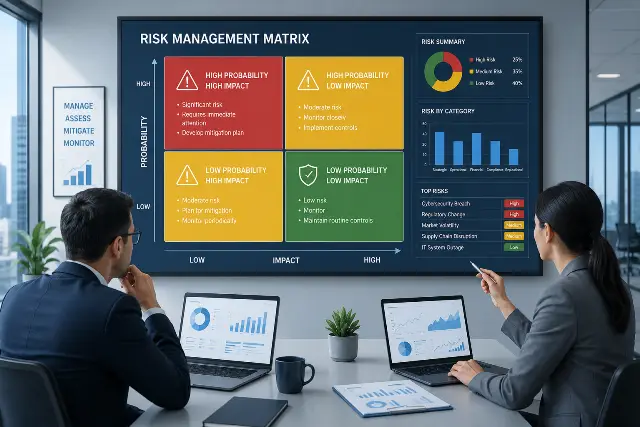
Develop a risk matrix with risks in quadrants (high probability/ high impact, high probability/ low impact etc.). High risk/High impact risks need to be addressed immediately.
Implementation And Monitoring
Take action to mitigate high priority risks. Set up accountability – one leader for each big risk. Set up risk exposure metrics for tracking over time. Check risk reports on a regular basis (quarterly/monthly) with senior management.
A continuous improvement and review process is in place.
A Continuous Process
Risk management is not a project, it is a process. Always review your risk assessment when your business changes. New strategies could bring new risks. Risks may be enhanced by changes in the market. Exposures may become apparent during external events.
Common Risk Management Tools And Approaches
There are a number of well-established tools that can be used to identify, evaluate and reduce business risks.
SWOT Analysis
SWOT (Strengths, Weaknesses, Opportunities, Threats) is a good way to strategically position your company:
Although easy to use, SWOT also offers a systematic approach to considering various risk types.
Risk Matrix And Heat Maps
Risk matrices map out risks based on probability and impact to make it easy to see where focus is necessary. Using a color code (red, yellow, green), the heat maps are immediately recognizable when assessing risk levels.
Enterprise Resource Planning (ERP) Systems
Because ERP systems connect financial, operational, and supply chain data, anomalies can be identified more easily and important metrics can be tracked and monitored in real-time, along with risk indicators.
Insurance And Risk Transfer
Insurance transfers some financial risk to the insurance company. Specific loss scenarios are covered by various types of insurance, such as liability insurance, property insurance and specialized policies. While insurance doesn’t eliminate risk, it limits financial consequences.
Conclusion
The basis of proper risk management is to know the kinds of business risk that your enterprise is facing. Each of these types of risk brings different assessment and mitigation techniques and can cause damage to your company’s finances, operations, or reputation.
We’ve covered most of the business risks that organizations face in the seven categories of business risk: financial, operational, strategic, compliance, market, reputational, and liquidity. But the threats your enterprise encounter is dependent on the industry you are in, the size of your enterprise, its competitive state, and strategic decisions.
The most successful organizations do not eliminate risk (which is impossible) but rather manage the risk strategically. They know what risk exposures they are at and what mitigation measures can be taken and regularly check progress. They navigate risk and opportunity, make informed decisions to grow their businesses and ensure that they don’t endanger the organization.
Begin by doing an extensive risk assessment of your organization. Determine the greatest risks that could happen to you. Establish a risk management structure that has clear ownership and accountability. Reassess regularly your risk plan as your company grows up.
With so many unknowns in the business world today, strong risk management is not a luxury, but a must-have. Those who become proficient in it become more resilient, make better decisions and have improved financial results.
Frequently Asked Questions
1) What Is The Difference Between Business Risk And Financial Risk?
Business risk is a general term that applies to any uncertainty that can have an impact on an organization’s performance. Financial risk is a specific form of risk that involves cash flow, profitability and solvency. Financial risks are part and parcel of the business risk, but business risk does not necessarily mean financial risk. The source of the financial consequences of reputational risk may differ from that of operational risk, for instance.
2) What Are The Most Important Risks To Tackle?
Establish a matrix of probability and impact. High probability, high impact risks should be addressed immediately. Medium probability and medium impact risks need to be mitigated and can be addressed following critical exposures. Low probability, low impact risks can be monitored, but may not need active intervention. Invest in risks with the highest likelihood of impacting business continuity.
3) Can Insurance Eliminate Business Risk?
Insurance does not remove some of the financial risks but it does pass them. It will not stop the event from happening, but it will help you avoid catastrophic losses in certain situations. For instance, property insurance will cover your money if your house burns down but it won’t stop it from burning. A comprehensive Risk Management Program means using insurance, prevention, mitigation and contingency planning.
4) How Frequently Should We Update Our Risk Management Plan?
For most organizations, quarterly reviews are appropriate. Track risk factors every month or week for critical exposures. Periodic re-evaluations at least once a year or when major changes in the product mix (new products, new entrants, significant acquisitions, major competitive action, etc.). Risk management isn’t a one-off activity, it is a continuous process.
5) In The Business World, What Is The Relationship Between Risk And Opportunity?
The greatest profit often goes hand-in-hand with the greatest risks. Smart risk management is not a risk management without risk, but a proper risk management. There are risks that it is OK to do, and there are risks that you should not take. This is about balancing risk taking with what you want to achieve in your business and reducing the risk of unnecessary or disproportionate risk.
6) What Is The Small Business Approach To Risk Management When It’s On A Shoestring Budget?
Small businesses can prioritize effectively – first risks that could kill the business (financial insolvency, significant operational disruption, legal violation). Employ basic risk matrices rather than pricey software. Use insurance as an effective method of risk management for some risks at an affordable cost. Ensure all team members are engaged in risk identification; small teams often can see problems clearly. Begin with a few steps and develop them as the business grows.
7) Why Do Companies Sometimes Overlook The Obvious Risks?
Some of the drivers to risk blindness include: Overconfidence due to previous success; Urgency of day-to-day operations; Cognitive biases (the belief that “it won’t happen to us”); Lack of understanding and expertise in identifying risks; and Incentives (short-term success is rewarded, not managing risks over the long-term). Intentionally designed processes and leadership buy-in are needed to overcome these human instincts for effective risk management.
8) What Is The Difference Between Strategic Risk And Other Business Risks?
The business decisions that are made – going into the wrong market, pursuing the wrong strategy, and not innovating, are all examples of strategic risks. Strategic risk is the risk that the company has the wrong strategy, whereas operational or financial risk (executing it well). It’s usually found by market research, competitive analysis, not by process review.

