

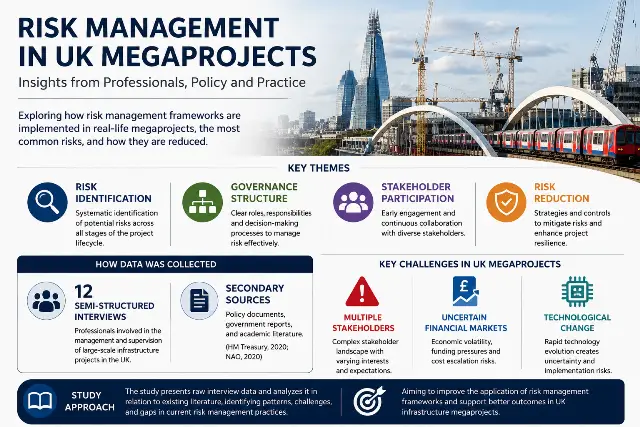
The UK’s long-term investment in rail, energy, hospitals, and transport means effective risk management has never been more important. Every megaproject carries unique financial, technical, environmental assessment, and political risks that require structured governance throughout the project lifecycle. This guide explains how project leaders identify, assess, and control risk in UK infrastructure megaprojects, drawing on real case studies, established frameworks, and lessons from decades of delivery experience.
Why UK Infrastructure Megaprojects Carry High Risk
Megaprojects carry risk profiles unlike smaller builds. Their scale multiplies every variable, from labour shortages to material costs, and most span ten years or longer — long enough for political administrations, funding priorities, and market conditions to shift more than once. Cost overrun risk remains one of the most documented challenges in the sector: research by Professor Bent Flyvbjerg puts the average cost overrun across global infrastructure projects at 39%, rising to 40% for rail schemes specifically. In the UK, the National Audit Office has found that more than 70% of large infrastructure projects exceed their original budget by upwards of 10%.
Complexity compounds the problem. A rail line like HS2 touches hundreds of landowners, local authorities, and environmental bodies, and each stakeholder introduces a potential friction point. Weather delays, ground conditions, and supply chain disruptions add further uncertainty, so small problems often cascade into larger ones. Meanwhile, taxpayer-funded projects face constant media attention — any delay or budget increase becomes a national headline, which pressures teams to manage risk transparently and proactively.
The government’s own Major Projects Portfolio illustrates the scale involved: as of 2023–24 it tracked 227 projects with a combined whole-life cost of £834 billion, within which a subset of true megaprojects carries an estimated whole-life cost exceeding £160 billion.
Core Categories of Risk in Megaprojects
Understanding risk categories helps teams build targeted mitigation plans. Most UK infrastructure programmes group risk into the following core areas.
Financial and Cost Risk
Inflation, currency fluctuation, and material price spikes all threaten fixed budgets. Project leaders typically reserve 10–20% of budgets as a financial buffer, though experience across the sector suggests generic percentage buffers often prove insufficient for true megaproject complexity. Robust contingency planning remains the primary defence.
Schedule and Delivery Risk
Timelines slip for many reasons, including permitting delays, design changes, and weather events. Schedule risk assessment identifies which phases carry the highest delay potential so teams can build slack into critical-path activities.
Political and Regulatory Risk
Government priorities shift with elections and spending reviews, and a fully funded project today may face cuts tomorrow. Regulatory changes, such as new environmental laws, can force costly redesigns, so political risk requires constant monitoring of policy signals and parliamentary debate.
Environmental and Planning Risk
UK planning law demands extensive environmental assessment, and protected habitats, archaeological sites, and heritage buildings all complicate approvals. Early engagement with regulators significantly reduces this exposure.
Stakeholder and Reputational Risk
Local communities, landowners, and advocacy groups influence project momentum. Poor communication breeds opposition and legal challenges, and reputational damage from safety incidents or cost scandals can erode public trust permanently. Ongoing stakeholder engagement is the main safeguard.
Technical and Construction Risk
Ground conditions, structural design errors, and equipment failures all create technical exposure. Tunnelling projects face unique underground uncertainties, while bridges and viaducts demand precise engineering tolerances — which is why construction risk management relies heavily on rigorous quality control.
Workforce and Skills Risk
Megaprojects depend on specialised labour that is often scarce, and skilled engineers, tunnellers, and electricians take years to train. A shortage in any single trade can stall an entire workstream. Training academies linked to major programmes help build a sustainable talent pipeline; without that investment, projects compete for the same limited pool of specialists, driving up labour costs and extending timelines.
Supply Chain and Material Risk
Steel, concrete, and specialist components often come from international suppliers, so shipping delays and price volatility introduce planning uncertainty. Teams that map their supply chains early can identify single points of failure before they cause disruption, supporting long-term supply chain resilience.
Established Frameworks for Managing Megaproject Risk
UK infrastructure bodies rely on recognized frameworks rather than ad hoc approaches, which brings consistency and accountability to complex programmes.
ISO 31000 Risk Management Principles
ISO 31000 provides a globally recognized structure for identifying and treating risk, emphasizing continuous review rather than one-time assessment. Many UK contractors align their internal risk registers with this standard.
HM Treasury Green Book Guidance
The Green Book guides public sector investment appraisal across the UK and requires teams to quantify both risks and benefits before approval. Optimism bias adjustment is a core requirement — project sponsors must inflate initial cost estimates to account for a well-documented, decades-long pattern of underestimation.
RIBA Plan of Work
The RIBA Plan of Work structures design and construction stages with defined risk checkpoints at each one, helping architects and engineers flag issues before they escalate.
PRINCE2 and Programme Management Frameworks
PRINCE2 offers structured project governance widely used across UK public projects, defining clear roles for risk ownership at every management level. Programme management frameworks extend this structure across multiple linked projects, which is essential where workstreams are interdependent.
Real-World Case Studies from UK Megaprojects
Case studies reveal how theory translates into practice — and where risk management sometimes falls short.
HS2 High-Speed Rail
HS2 remains the UK’s most scrutinized infrastructure programme. Its budget has grown substantially since initial approval — early estimates of around £56 billion have since risen well beyond £100 billion — driven by ground condition surprises, land acquisition disputes, and design changes. The National Audit Office has pointed to unclear early objectives, with journey-time savings and wider economic goals pulling design decisions in different directions. HS2’s experience underlines why contingency planning must reflect true project complexity rather than optimistic assumptions.
Crossrail (Elizabeth Line)
Crossrail’s budget rose from an initial £14.8 billion to around £18.7 billion, and the project opened more than three years later than planned. Software integration problems between signalling systems caused significant unexpected setbacks; recovery involved bringing in specialist engineering resources and revising governance structures. Crossrail’s lessons highlight the importance of systems integration risk in complex rail projects.
Hinkley Point C Nuclear Plant
Hinkley Point C illustrates risk management in the energy sector, where strict safety regulation and long approval cycles are the norm. Supply chain disruptions and skilled labour shortages have extended timelines, and the project’s contractual structure — including government-backed price guarantees — spreads financial risk between the developer and government.
Thames Tideway Tunnel
London’s “super sewer” used an innovative risk allocation model in which private investors shared construction risk with government backstops. This structure protected taxpayers while attracting private capital, offering a model for future infrastructure financing.
Risk Allocation and Contract Structures
Contract design directly shapes how risk gets shared between parties, and poor allocation creates disputes and cost escalation.
NEC4 Contracts
The NEC4 suite is widely used across UK infrastructure and encourages collaborative risk management through early warning mechanisms — contractors must flag potential problems before they become formal claims, reducing the adversarial disputes common under older contract management forms.
Public-Private Partnerships
Public-private partnership models transfer specific risks to private partners: construction risk often shifts to contractors, while demand risk may stay with government. Clear allocation prevents costly renegotiation later in the project lifecycle.
Risk Registers and Contractual Clauses
Every major UK infrastructure contract includes a living risk register, tracking identified risks, ownership, and mitigation status, with contractual clauses defining the financial consequences when a risk materializes. Effective teams review and update this register on a rolling basis — often monthly, or weekly during critical phases — logging new risks as they emerge and formally closing resolved ones.

Practical Risk Mitigation Strategies for UK Infrastructure Projects
Strong frameworks mean little without practical execution.
- Early stakeholder engagement. Public consultation should start during feasibility studies, not after design approval. Transparent communication builds trust and reduces legal challenges later.
- Robust contingency planning. Contingency budgets and schedule buffers should be based on historical data from comparable projects rather than generic percentages.
- Phased delivery and modular construction. Breaking megaprojects into smaller phases reduces overall risk exposure, and off-site modular methods lower weather-related delays.
- Independent assurance reviews. The government’s Infrastructure and Projects Authority conducts regular project assurance reviews on major programmes, flagging risks that internal teams may overlook because of optimism bias.
- Supply chain diversification. Spreading suppliers across regions and sectors reduces vulnerability to single points of failure and strengthens overall supply chain resilience.
- Scenario planning and stress testing. Modelling best-case, expected-case, and worst-case outcomes reveals hidden vulnerabilities in budgets and schedules.
Many UK megaprojects also run monthly risk review workshops, where project teams reassess emerging threats and update mitigation actions — a practical habit that keeps the risk register a living document rather than a filing exercise.
The Role of Technology in Modern Risk Management
Digital tools now play a central role in identifying and tracking risk across megaprojects.
Building Information Modelling (BIM)
BIM creates detailed digital models of infrastructure before construction begins, letting teams identify design clashes and structural issues early and avoid costly on-site rework.
Digital Twins
Digital twin technology creates live, data-connected models of physical assets that engineers use to simulate stress scenarios and predict maintenance needs, powering predictive analytics that help teams act before failures occur.
Data Analytics and AI Forecasting
Advanced analytics platforms process historical project data to flag likely risks and schedule-slippage patterns earlier than traditional methods, supporting — rather than replacing — human judgment.
Real-Time Monitoring Systems
Sensors on bridges, tunnels, and rail infrastructure track structural performance continuously and alert teams to anomalies before they escalate into safety incidents. This is now standard on major UK rail and energy projects.
Insurance and Financial Risk Transfer
Insurance plays a supporting role alongside contractual risk allocation. Construction all-risks policies cover physical damage during the build phase; professional indemnity insurance protects against design errors from engineers and architects; and delay-in-start-up cover compensates for lost revenue when completion slips beyond agreed dates.
Large programmes sometimes use captive insurance structures, retaining and managing certain risks internally rather than transferring every exposure to the open market — an approach that can reduce premium costs over a megaproject’s long life, provided the sponsor holds sufficient financial reserves to absorb claims. Government guarantees also feature in major energy and transport schemes: Hinkley Point C’s financing model, for example, includes government-backed price guarantees that reduce investor risk and help attract private capital into projects with long payback periods.
Governance and Organizational Structures for Risk Oversight
Strong governance keeps risk management consistent across a project’s lifecycle.
The Infrastructure and Projects Authority
This government body oversees major UK infrastructure programmes, provides independent assurance, and reports directly to the Treasury. Its reviews carry significant weight in funding decisions.
Risk Committees and Escalation Paths
Large programmes establish dedicated risk committees with senior decision-making authority. Clear escalation paths ensure critical risks reach leadership quickly, since delayed escalation often turns manageable problems into crises.
Integrated Risk Culture
Risk management works best when embedded into daily operations rather than treated as a separate function. Training programmes that help every team member recognize and report emerging risks reduce reliance on formal reporting alone.
Key Lessons from UK Infrastructure Megaprojects
Decades of delivery experience have produced a consistent set of lessons. Optimism bias remains a persistent challenge: early estimates almost always underestimate true cost and schedule requirements, and teams that build realistic contingencies from the outset avoid painful renegotiations later. Contract design shapes behavior, too — collaborative contracts like NEC4 tend to produce better risk outcomes than adversarial, blame-focused structures.
By contrast, technology adoption only improves outcomes when paired with investment in training; digital tools add value only when teams understand how to interpret their outputs. Independent assurance catches blind spots that internal teams, naturally optimistic about their own projects, tend to miss.
In practice, communication between government and delivery teams must stay consistent, since political changes can disrupt funding commitments mid-project. Programmes that maintain clear reporting lines to Treasury and Parliament tend to weather these transitions more smoothly than those operating in isolation. Data quality also determines forecasting accuracy: programmes that invest in consistent, well-documented reporting build stronger predictive capability, and those lessons feed forward into future Green Book guidance and Infrastructure and Projects Authority benchmarks.
Flexibility matters as much as discipline. Rigid plans that cannot adapt to new information often fail more dramatically than those built with structured decision points for course correction — the best-performing UK megaprojects combine firm governance with the flexibility to revise assumptions as real conditions emerge.
Conclusion
Risk management in UK infrastructure megaprojects requires structured frameworks, honest cost estimation, and proactive stakeholder engagement. Case studies from HS2, Crossrail, and Hinkley Point C show both the pitfalls and the progress made across the sector, while strong governance, collaborative contracts, and modern digital tools continue to reduce uncertainty in these complex programmes. As UK infrastructure investment accelerates, organizations that combine realistic planning, collaborative governance, data-driven decision-making, and continuous risk monitoring will be best positioned to deliver complex projects on time, within budget, and with lasting public value.
Frequently Asked Questions
What is risk management in UK infrastructure megaprojects?
It is the structured process of identifying, assessing, and controlling risks across large-scale public infrastructure programmes, including financial, schedule, environmental, and political risk factors that could affect delivery.
Why do UK megaprojects often exceed their original budgets?
Optimism bias, ground condition surprises, and evolving scope commonly drive cost overruns. Political and regulatory changes over long timelines also add unplanned expense that early estimates rarely anticipate. National Audit Office analysis has found that more than 70% of large UK infrastructure projects exceed their original budget by more than 10%.
What frameworks do UK infrastructure projects use for risk management?
Common frameworks include ISO 31000, HM Treasury’s Green Book, PRINCE2, and the RIBA Plan of Work. Each provides structured guidance for identifying, assessing, and governing project risk.
How does the Infrastructure and Projects Authority help manage risk?
It conducts independent assurance reviews on major government-funded programmes, identifying risks that internal teams may overlook and informing funding and delivery decisions at a national level.
Can technology really reduce risk on megaprojects?
Yes — tools like BIM and digital twins help teams spot design clashes and predict maintenance needs early. However, technology supports human decision-making rather than replacing experienced judgment entirely.
What is optimism bias in project risk management?
It refers to the tendency to underestimate costs, timelines, and risks during early planning. The Green Book requires teams to adjust estimates upward to counter this well-documented pattern.
How do contracts like NEC4 affect risk outcomes?
NEC4 encourages early warning and collaboration between contractors and clients, a proactive structure that reduces disputes compared with older, more adversarial contract models.
What role does stakeholder engagement play in reducing project risk?
Early, transparent engagement with communities and regulators reduces opposition and legal challenges. Projects that delay consultation often face costly setbacks later in the delivery timeline.
Who is responsible for risk management on a UK megaproject?
Responsibility is shared across several roles. The client sets overall risk appetite and funding envelopes; the principal contractor manages construction and supply chain risk day to day; a dedicated risk manager maintains the risk register and coordinates mitigation; the project board makes escalation and funding decisions; and, for major government programmes, the Infrastructure and Projects Authority provides independent assurance and reports upward to the Treasury.
Sources referenced: National Audit Office, HM Treasury, and academic research on infrastructure cost overruns (Flyvbjerg et al.).

