

Every business faces uncertainty. A supplier fails, a market shifts, or a system crashes overnight. Risk management analysis gives leaders a structured way to spot these threats early. It turns guesswork into informed decisions.
This guide walks through a practical, step-by-step approach. You will learn how experienced risk managers identify, measure, and control risk. The goal is simple: fewer surprises and stronger business performance.
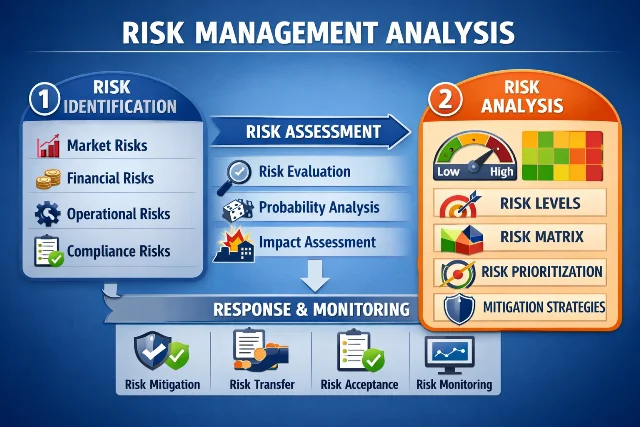
What Is Risk Management Analysis?
Risk management analysis is the process of identifying, evaluating, and prioritizing risks. It helps organizations understand what could go wrong before it happens. Analysts then rank each risk by its likelihood and potential impact.
This process is not a one-time task. It runs continuously across the life of a project or business. Markets change, regulations shift, and new technologies create fresh vulnerabilities.
A good analysis connects directly to decision-making. Leaders use the results to allocate budgets, set policies, and design controls. Without this step, risk management becomes reactive instead of strategic.
Many professionals confuse risk analysis with risk management. Risk analysis is one part of the broader risk management process. It focuses specifically on understanding and measuring risk, not just responding to it.
Why Risk Management Analysis Matters for Businesses
Companies that skip formal risk analysis often pay a steep price later. Small issues compound into major financial losses. A missed compliance requirement can trigger heavy fines.
Consider a mid-sized manufacturer that ignored supply chain risk. A single supplier disruption halted production for six weeks. That delay cost more than a proper risk review would have.
Strong analysis protects more than money. It protects reputation, employee safety, and customer trust. Insurance companies also reward businesses that show documented risk controls.
Regulators increasingly expect formal risk documentation too. Industries like banking, healthcare, and construction face strict oversight. A clear risk assessment matrix demonstrates due diligence during audits.
Beyond compliance, risk analysis supports smarter growth. Companies expanding into new markets need to understand unfamiliar risks first. This analysis becomes a foundation for confident expansion decisions.
5 Core Types of Risk in Business Analysis
Understanding risk categories helps analysts apply the right tools. Each type carries different causes, indicators, and mitigation approaches.
Financial Risk
Financial risk covers exposure to monetary loss. This includes currency fluctuations, credit defaults, and interest rate changes. Companies with international operations face heightened currency exposure.
Cash flow problems often signal underlying financial risk. Analysts track debt ratios and liquidity positions closely. Poor liquidity risk management can force emergency borrowing at unfavorable terms.
Banks and other regulated lenders follow guidance from the Basel Committee on Banking Supervision when analyzing credit and liquidity risk. These standards shape how institutions calculate capital reserves against potential losses. Even non-bank businesses can borrow from this approach when stress-testing their own cash reserves.
Operational Risk
Operational risk arises from internal processes, people, or systems failing. Equipment breakdowns, human error, and fraud all fall into this category. Manufacturing firms face this risk daily on production lines.
Technology failures also count as operational risk. A server outage can halt sales for hours. Strong operational risk management practices reduce these disruptions significantly.
Strategic Risk
Strategic risk involves decisions that affect long-term direction. Entering the wrong market or launching a flawed product both qualify. Competitors’ actions can also create strategic risk overnight.
Leadership teams often underestimate this category. They focus heavily on operational details while missing bigger market shifts. Strategic risk analysis requires looking years ahead, not just months.
Compliance and Legal Risk
Every industry operates under specific regulations. Failing to meet these standards creates legal exposure. Fines, lawsuits, and license revocations are common consequences.
Healthcare and finance face particularly heavy compliance burdens. A single data breach can trigger multiple regulatory investigations. Legal risk analysis must stay current with changing laws.
Reputational Risk
Reputational risk damages public trust and brand value. Social media has made this risk spread faster than ever. A single viral complaint can hurt sales within days.
This risk often follows other failures. Poor product quality or unethical practices frequently trigger reputational damage. Recovery from reputational harm usually takes longer than the original incident.
The 7-Step Risk Management Analysis Process
A structured framework keeps analysis consistent across projects and departments. These seven steps reflect industry best practices and align with ISO 31000 principles. The COSO Enterprise Risk Management framework, widely used in North America, follows a similar logic: set objectives, identify events, assess risk, and respond. Whichever standard an organization references, the underlying discipline stays the same.
Step 1: Establish Context and Objectives
Start by defining what the analysis needs to accomplish. Clarify the scope, whether it covers one project or the entire organization. This step also sets the criteria for measuring risk severity.
Leadership should agree on the organization’s risk appetite early. This defines how much uncertainty the business will accept. Without this baseline, teams struggle to prioritize findings later.
In practice, many risk appetite statements fail quietly. They get written once during annual planning and then sit untouched for years. A statement drafted before a major acquisition, a new regulation, or a market shock rarely still fits the business it was meant to guide. Revisiting the risk appetite after these events, not just on a fixed calendar date, keeps the entire analysis grounded in reality.
Step 2: Identify Potential Risks
Risk identification gathers every plausible threat facing the organization. Teams use brainstorming sessions, historical data, and expert interviews. Checklists based on industry standards also help uncover blind spots.
Cross-functional input strengthens this step considerably. Finance teams spot different risks than operations staff. Combining perspectives creates a more complete risk picture.
Document each identified risk in a risk register. This central record tracks details, owners, and status updates. It becomes the foundation for every later step.
Step 3: Analyze Risk Likelihood and Impact
This step measures how probable each risk is and how severe its consequences would be. Analysts typically use two approaches here.
Qualitative analysis ranks risks using descriptive scales like low, medium, or high. It works well for quick assessments or limited data situations. Teams can apply it without complex calculations.
Quantitative analysis assigns numerical values to likelihood and financial impact. This method suits risks with available historical data. It produces more precise, comparable results across different risk types.
Most organizations blend both methods depending on the risk category. Financial risks often get quantitative treatment. Reputational risks may rely more on qualitative judgment.
One detail experienced analysts learn the hard way: quantitative scores create a false sense of precision when the underlying data is weak. A risk rated “7.2 out of 10” can feel more scientific than a qualitative “high,” even when both rest on the same rough estimate. It is often more honest to pair a number with a confidence level, so decision-makers know how much weight the figure deserves.
Step 4: Prioritize Risks Using a Risk Matrix
A risk assessment matrix plots likelihood against impact on a simple grid. This visual tool helps teams see which risks need immediate attention. High-likelihood, high-impact risks sit in the critical zone.
Ranking risks this way prevents wasted effort on minor issues. Teams can focus limited resources where they matter most. The matrix also supports clear communication with executives who need quick summaries.
| Impact | ||||
| Likelihood | Minor | Moderate | Major | Severe |
| Likely | High | Critical | Critical | Critical |
| Possible | Medium | High | Critical | Critical |
| Unlikely | Low | Medium | High | Critical |
| Rare | Low | Low | Medium | High |
Review the matrix regularly, since risk positions shift over time. A risk that seemed minor last quarter might become critical after a market change.
Step 5: Develop Risk Response Strategies
Once risks are prioritized, teams choose how to handle each one. Four common strategies apply here.
Avoidance eliminates the activity causing the risk entirely. This works when potential losses outweigh any benefit. Reduction lowers the likelihood or impact through preventive controls.
Transfer shifts the risk to another party, often through insurance or contracts. Acceptance applies when the cost of mitigation exceeds the potential loss. Small, low-impact risks often fall into this category.
Selecting the right strategy requires balancing cost against protection level. Over-investing in low-priority risks wastes resources needed elsewhere.
Step 6: Implement Risk Control Measures
Turning strategy into action is where many organizations struggle. Assign clear ownership for each risk control measure. Without accountability, controls often fail to get implemented properly.
Practical controls include employee training, backup systems, and updated policies. Physical safeguards like fire suppression systems also count as controls. Document each control alongside its associated risk in the register.
Timeline matters here too. Critical risks need controls implemented immediately, not next quarter. Set realistic deadlines and track progress against them consistently.
Step 7: Monitor and Review Continuously
Risk analysis is never truly finished. New risks emerge as business conditions change. Regular reviews catch these shifts before they cause damage.
Schedule formal reviews quarterly or after major business changes. Track key risk indicators that signal emerging problems early. This ongoing risk monitoring process keeps the entire framework relevant and useful.
Update the risk register after every review cycle. Remove resolved risks and add newly identified ones. This keeps the document accurate and genuinely useful for decision-makers.

Risk Management Analysis in Action: Real-World Examples
Abstract frameworks become clearer through concrete examples. These three short cases show how the same core process adapts across very different industries.
A regional bank struggled with inconsistent loan approvals across branches. Loan officers relied heavily on personal judgment, which produced uneven default rates. By introducing quantitative risk analysis, the bank scored applicants against historical repayment data. Default rates dropped within two quarters, and approval decisions became far more consistent across locations.
A hospital noticed a pattern of near-miss medication errors during shift changes. An operational risk review mapped each step of the medication handoff process. The review found that verbal handoffs, without a written checklist, were the main failure point. Adding a simple double-check form reduced reported errors by a meaningful margin within the first year.
An IT services company depended heavily on a single cloud vendor for critical infrastructure. Early risk identification flagged this as a significant vendor lock-in risk. The company began phasing in a multi-cloud architecture before any outage occurred. When that vendor later suffered a major service disruption, the company’s operations continued with minimal impact.
Each case follows the same underlying pattern: identify the risk early, analyze it honestly, and act before the cost becomes unavoidable.
Common Tools and Techniques for Risk Analysis
Several established tools support the analysis process across industries. SWOT analysis examines strengths, weaknesses, opportunities, and threats together. It works well during the context-setting phase.
Failure Mode and Effects Analysis (FMEA) examines potential failure points in processes. Manufacturing and engineering teams rely on this method heavily. It ranks failures by severity, occurrence, and detection difficulty.
Monte Carlo simulations model thousands of possible outcomes for complex projects. This technique suits large capital projects with significant financial exposure. It produces probability distributions rather than single estimates.
Bowtie analysis visually connects causes, an event, and consequences. This method works especially well for operational and safety risks. Teams can see prevention and mitigation controls on the same diagram.
Choosing the right tool depends on risk complexity and available data. Simple projects rarely need Monte Carlo simulations. Complex financial portfolios rarely benefit from basic checklists alone.
Risk Management Analysis in Project Management
Projects carry unique risk profiles compared to ongoing business operations. Scope creep, budget overruns, and timeline delays represent frequent project risks. Early analysis prevents these issues from derailing the entire project.
The PMBOK Guide, published by the Project Management Institute, treats risk management as a core knowledge area. It recommends the same identify-analyze-respond cycle used in this guide, applied specifically to project timelines and deliverables. Project managers who follow this structure tend to catch scope and budget risks earlier.
Project managers typically build a risk register during initial planning. This document evolves throughout the project lifecycle. Regular status meetings should include a risk review agenda item.

Stakeholder communication plays a critical role here. Sponsors need visibility into major risks without excessive technical detail. Clear, concise risk summaries maintain trust throughout the project timeline.
Construction and IT projects face particularly high risk exposure. Weather delays, vendor issues, and technology changes all threaten deadlines. Applying the seven-step framework early reduces the chance of costly surprises.
Risk Management Analysis for Small Businesses
Small businesses often assume formal risk analysis only suits large corporations. This assumption creates unnecessary vulnerability. Limited resources actually make small businesses more sensitive to unexpected losses.
A simplified version of the framework still delivers real value. Owners can start with a basic risk register covering top concerns. Common areas include cash flow, key employee dependency, and cybersecurity gaps.
Insurance review should accompany any small business risk analysis. Many owners carry outdated coverage that no longer matches their operations. A broker consultation often reveals coverage gaps quickly.
Succession planning also deserves attention in smaller companies. Losing a key founder or manager can threaten survival. Documenting critical knowledge reduces this often-overlooked risk.
Common Mistakes in Risk Management Analysis
Several recurring errors weaken risk analysis effectiveness. Recognizing these mistakes helps teams avoid repeating them.
Treating risk analysis as a one-time exercise ranks among the biggest errors. Businesses change constantly, and static analysis quickly becomes outdated. Continuous review keeps the process genuinely useful.
Relying on a single perspective also limits accuracy. Risk teams that exclude frontline employees miss operational insights. These employees often spot practical risks that executives overlook entirely.

Overcomplicating the process discourages consistent use. Some organizations build elaborate frameworks that teams find too cumbersome. Simpler, sustainable processes usually outperform complex ones nobody follows.
Ignoring low-probability, high-impact risks creates dangerous blind spots. These rare events, sometimes called black swan risks, can cause severe damage. A balanced analysis considers both frequent and rare scenarios.
Finally, failing to link analysis with action wastes the entire effort. Identifying risks without implementing controls provides little real protection. The analysis must connect directly to concrete next steps.
Building a Risk-Aware Culture
Technical frameworks only work when supported by the right culture. Employees at every level should feel comfortable reporting concerns. Punishing honest risk reporting discourages future disclosure.
Leadership sets the tone through visible commitment to the process. Regular communication about risk priorities keeps the topic relevant. Training sessions help staff recognize risks within their own roles.
Recognition programs can reinforce good risk behavior too. Acknowledging employees who identify significant risks encourages participation. This cultural shift often matters more than any specific tool or template.
Conclusion
Risk management analysis transforms uncertainty into actionable insight. By following a structured process, businesses identify threats early and respond with confidence. From financial exposure to operational disruptions, every risk category benefits from consistent review.
The seven-step framework offers a practical starting point for any organization. Pair it with the right tools, honest communication, and continuous monitoring for lasting results. Organizations that consistently review and update their risk analysis are better positioned to reduce uncertainty, allocate resources wisely, and respond confidently to changing conditions. Whether you run a startup or a multinational enterprise, investing in structured risk analysis today helps prevent costly decisions tomorrow. Start small if needed, but start now.
Frequently Asked Questions
What is the difference between risk analysis and risk assessment?
Risk analysis examines the likelihood and impact of specific risks in detail. Risk assessment is broader, combining analysis with prioritization and response planning. Analysis is essentially one component within the larger assessment process.
How often should a business conduct risk management analysis?
Most organizations review risks quarterly, though this varies by industry. Highly regulated sectors like finance may require more frequent reviews. Major business changes, like new product launches, should also trigger fresh analysis.
What is a risk assessment matrix used for?
A risk assessment matrix visually ranks risks by likelihood and potential impact. It helps teams prioritize which risks need immediate attention. This tool also simplifies communication with executives and stakeholders.
Can small businesses benefit from formal risk analysis?
Yes, small businesses often benefit even more due to limited financial cushioning. A simplified risk register covering key concerns still provides real protection. Even basic analysis beats having no process at all.
What is the difference between qualitative and quantitative risk analysis?
Qualitative analysis uses descriptive rankings like low, medium, and high. Quantitative analysis assigns specific numerical values and financial estimates. Many organizations use both methods depending on available data.
What tools are commonly used in risk management analysis?
Common tools include SWOT analysis, FMEA, Monte Carlo simulations, and bowtie analysis. The right choice depends on risk complexity and data availability. Simple projects often only need basic checklists and matrices.
How does ISO 31000 relate to risk management analysis?
ISO 31000 provides internationally recognized principles and guidelines for risk management. It offers a flexible framework rather than strict certification requirements. Many organizations align their analysis process with these established principles.
What happens if a business ignores risk management analysis?
Ignoring risk analysis increases exposure to financial loss, legal trouble, and reputational damage. Small issues can compound into major disruptions over time. Regulators and insurers may also penalize businesses lacking documented risk processes.

