

All organizations are heavily reliant on cash. Businesses can go bankrupt if they don’t have enough cash on hand. That’s where the liquidity risk management comes into play. It guarantees that companies and financial institutions will be able to pay the bills without delay.
Liquidity risk management is anything but a banker’s problem. The challenge that is common to all retailers, manufacturers and start-ups is the same. They need to keep a track of incoming and outgoing cash at all times.
This guide offers an overview of the meaning of liquidity risk management, its importance and how to create a solid framework for it. There will also be practical tools, real-life examples and best practices from the industry.
What Is Liquidity Risk Management?
Liquidity risk management is the identification, measurement and management of an organization’s ability to satisfy its financial obligations. It is geared towards having a healthy cash flow or liquid funds on hand when needed.
Even a solvent company can have serious problems if it doesn’t have proper liquidity risk management. A company may have assets that are worth a lot, but have difficulty paying suppliers or employees on time.
This is one of the disciplines that banks are closely monitoring. Banks are supposed to have enough cash to meet requests for withdrawal or sudden changes in the market. This safeguards the depositors and financial stability in the overall economy.
The liquidity risk management approach is slightly different for nonfinancial businesses. Usually includes the surveillance of working capital, payment conditions and the keeping of emergency credit lines.
The Importance of Liquidity Risk Management to Businesses and Banks
However, cash shortages do not often occur without warning signs. Often the poor liquidity risk management is slowly apparent and becomes a crisis. Late payments from customers, fluctuations in sales based on the season or unexpected expenditures can all cause issues.

The 2008 financial crisis has been a strong reminder of this. But several primary banks had on their books sufficient assets which they were unable to liquidate in time. This shortfall in terms of solvency risk and liquidity actually led to a large number of failures.
There are multiple ways that good liquidity risk management helps to safeguard an organization:
- It eliminates the risk of paying suppliers, employees and creditors late.
- It lowers the need for tackling high cost emergency borrowing.
- It fosters investor and regulatory confidence and business partnerships.
- It encourages long-term growth, rather than forced asset sales.
Many small and medium-sized companies don’t think about this risk. They believe that only a financially troubled company or large bank would have problems with liquidity. But in fact, growth can be just as much of a strain on cash flow as a downturn.
Suppose that a popular fast food restaurant chain is opening new stores. Every new store will need the initial capital to purchase goods, hire employees and pay the rent. Even with high overall sales, if sales and expenses are not in balance due to new revenue, the company may be in trouble with its liquidity.
The ability of a company to manage this risk is an important consideration for investors and lenders. Failure to make payments or emergency loans may have a negative effect on credit ratings. This increases the cost of future borrowing a great deal.
Liquidity Risk Management is a sign of market discipline for operations. It assures stakeholders of the understanding of stakeholders’ leaders about growth opportunities and risks.
Types of Liquidity Risk
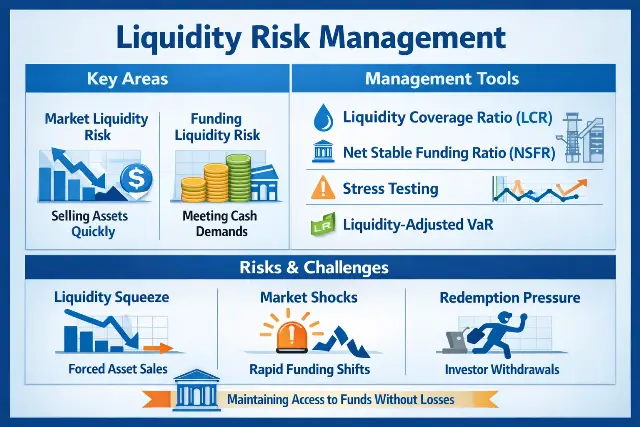
Knowing of the various categories enables organizations to use the appropriate controls. The risks associated to liquidity risks are typically of two types.
Funding Liquidity Risk
Funding liquidity risk is the risk that an organization will not be able to access cash to pay its debts. This could occur if lenders tighten their lending policy or investors grow uncertain.
This is a particular risk in times of financial difficulty for banks. A bank could have trouble meeting withdrawals if they are coming in more quickly than anticipated. Also referred to as the liquidity run.
This is a similar issue that businesses encounter. A tightening of credit could cause a business that heavily relies on short-term loans to not have the ability to pay bills.
Market Liquidity Risk
Market liquidity risk is the risk of not being able to sell assets at a reasonable price if the assets are liquidated. Other assets, such as government bonds, are easily traded even in the eyes of crisis.
Other assets like special equipment or real estate are less easily liquidated. At a down time, some asset classes might have no buyers at all.
Those organizations that carry illiquid assets require a more robust liquidity risk management plan. They are not confident that these assets will be able to be liquidated if there’s a shortfall in funds.
Mortgage-backed securities are a good example of how they function during the financial crisis of 2008. These assets had been trading for many years and then suddenly, there was hardly anyone who wanted to purchase them. The large holdings institutions found that their liquidity risk was significantly higher than their estimates.
Operational Liquidity Risk
The third group of operational liquidity risk is less talked about. This happens when there are internal issues such as system down time or payment issues which do not allow cash to be available in time.
If systems operating in the organization stop working, even those that have good reserves may experience temporary liquidity issues. If a bank has a technology outage, they may not be able to do on-time transactions or cash withdrawals.
This can be addressed through incorporating operational resilience into the liquidity risk management planning. This exposure is mitigated by backup systems, manual processing procedures, and having clear escalation paths.
Key Elements of an Effective Liquidity Risk Management Program
The four activities are linked and the integrity of the entire approach is based on them. The stages are designed to layer on to provide a fuller picture of risk.
Liquidity Risk Identification
The first step is to identify the potential for liquidity mismatch. These encompass payment programs, debt repayments and seasonal cash flow trends.
All significant cash inflows and cash outflows should be plotted on an organization’s cash flow chart. This helps to provide insight into any possible mismatch in timing in advance of it becoming critical.
Concentrations risks are also identified during this process. For instance, over-dependence on a single customer or lender provides an additional risk should there be a sudden change.
Liquidity Risk Measurement
Risks need to be quantified with a measurement that is based on reliable data. The most common indicators are the liquidity coverage ratio and net stable funding ratio.
The ratios are the relationship of the liquid resources and the short-term debt. A healthy ratio means that the organisation is able to sustain a defined period of stress without assistance.
There should be several time horizons for measurement. Daily measurement will identify problems quickly, while monthly and quarterly measurements will show the trends over a longer period of time in relation to the management of the balance sheet.
Liquidity Risk Monitoring
Ongoing monitoring makes sure that liquidity positions are kept in an acceptable range. This usually means that they monitor cash flow daily or weekly, particularly for banks and big companies.
Finance teams can identify early warning signs with dashboards and automated alerts. Sudden decreases in cash reserve should be examined immediately, not as a delayed reaction.
Clear escalation pathways also need to be in place in order to make monitoring effective. Any staff member that suspects a problem must know who they should report to and how much time they have to wait.
Liquidity Risk Control
Control mechanisms make monitoring information into action. This could involve altering the credit terms, boosting cash reserves or even taking up a credit facility.
The influence of good governance also is felt here. Clear policies are established regarding who will approve emergency funding and when.
Regular reporting to senior management and, if applicable, the board of directors, puts an end to the process. This helps to make sure liquidity risk management is not a “background activity.”
Key Liquidity Risk Management Tools and Techniques
The practical tools enable liquidity risk management to be put into action, rather than left as a theoretical concept. Here are the most common techniques in use throughout the various industries.
Liquidity Risk vs Credit Risk vs Market Risk
| Liquidity risk | Credit risk | Market risk | |
|---|---|---|---|
| Definition | Inability to access cash when it’s needed to meet obligations | Chance that a borrower fails to repay a loan or debt | Potential losses from changes in interest rates, currency, or asset prices |
| Root cause | Cash flow mismatch, lender pullback, or investor uncertainty | Borrower default, weakening credit quality | Volatility in rates, prices, or exchange rates |
| Typical trigger | Deposit run, late customer payments, credit tightening | Loan default, missed payment, bankruptcy | Rate hikes, currency swings, market crashes |
| Example | A bank can’t meet a sudden wave of withdrawals | A borrower stops repaying a business loan | A bond’s value drops as interest rates rise |
| Key metric | Liquidity coverage ratio, net stable funding ratio | Credit rating, probability of default | Value at risk, duration, beta |
| Main mitigation | Cash reserves, diversified funding, contingency plans | Credit checks, collateral, diversification of borrowers | Hedging, diversification, stress testing |
Cash Flow Forecasting
Good liquidity risk management starts with accurate cash flow forecasting. It forecasts inflow and outflow on a daily, weekly and monthly basis.
Have a “base case” and a “stress case” scenario for businesses. This is a two-way test to see how the organization will respond to an unexpected challenge.
Liquidity Coverage Ratio
The liquidity coverage ratio is used to determine if a bank has adequate liquid assets. It is a comparison of these assets with expected net cash outflows for a 30-day stress period.
This standard is a result of the Basel III reforms in response to the global financial crisis. It ensures bank’s ability to withstand liquidity shocks.

Stress Testing
Liquidity stress testing assumes extreme and reasonable scenarios. These can range from the loss of key customers or an increase in the number of loans defaulted on.
These simulations are useful to the management for understanding worst case exposure. They also help identify shortcomings in current liquidity risk management before problems arise.
Contingency Funding Plans
A contingency funding plan spells out the actions that need to be taken in the event of a liquidity crisis. It establishes back-up funding sources (e.g., credit line, sale of assets).
This plan should have the activation criteria clearly defined. It is often too late when an emergency is actually happening, and too early to seriously consider your options.
Liquidity Ratios to Monitor on a Routine Basis
In addition to the regulatory ratios, there are some traditional ratios which will help teams monitor liquidity constantly. These can be particularly helpful for non-financial companies.
The current ratio is the ratio of current assets to current liabilities. RATIO’s > 1 indicate that the organization is likely to meet liquidity requirements.
A tougher look is taken at the quick ratio, also known as the acid-test ratio. It doesn’t include inventory, as inventory can turn into cash in a different time.
Cash conversion cycle is the time it takes to convert inventory to cash and receivables back to cash. The shorter the cycle, the more effective the liquidity risk management.
These ratios can be followed over time and bring in some trends that may not be found from a single snapshot. A gradual deterioration, for instance, in a firm’s current ratio may indicate developing liquidity problems before a crisis actually arises.
Technology and Liquidity Risk Management Software
A number of organizations today are using dedicated software to bolster their liquidity risk management efforts. These systems streamline cash-flow forecasting and bring together data from various accounts.
Treasury management systems can be seamlessly connected to banking systems. This means that there is less manual data entry and more accurate daily liquidity positions.
Banks may find liquidity risk management software systems that are tailored for them to have integrated stress testing functionality. These tools automatically model regulatory ratios, thereby saving lots of compliance time.
Alternatively, simpler cloud-based accounting and forecasting tools can be used by smaller companies to deliver the same benefits. For all companies, the objective is the same – real-time cash position visibility.
Liquidity Risk Management Across Different Industries
The priorities for liquidity risk management vary according to the industry. By comprehending the distinctions, organisations can select the most appropriate strategies as a one-size-fits-all method is seldom effective in practice.
Banking and Financial Services
The banks have the toughest liquidity risk management requirements, because they are part of the financial system. The liquidity coverage ratio and the net stable funding ratio are some of the ratios regulators are paying close attention to.
Interbank lending markets also are significant here. These relationships are important when banks are short of liquidity, as they will often borrow from each other during these events.
Retail and E-Commerce
Retail companies have high peaks and dips in cash flow throughout the year. There can be a lot of money to be made during the holidays, and a lot of cash to be managed during fall and winter months.
One of the most significant liquidity factors in this industry is inventory. Excessive stock can be a poor use of funds for sales, marketing, growth, or cash.
Manufacturing
Manufacturers frequently have to wait longer for customers to pay and longer to manufacture the products. This leaves a tacit space in between expenditure on raw materials and income.
An example of a strong liquidity risk management in manufacturing is negotiating with suppliers. It also involves keenly watching the cash conversion cycle so as to minimize the time that cash is tied up.
Startups and High-Growth Companies
Startups often have small buffers for cash flow as they scale rapidly. This has made the management of liquidity risk particularly crucial when there are fundraising gaps.
In fact, many startups go out of business not for failing on their business model, but because they run out of cash before they become profitable! Part of the control of this risk is careful planning of the runways.
Healthcare Organizations
Healthcare providers and hospitals may experience delayed reimbursements from insurance companies and government programs. This leaves a continuous shortfall in the provision of services and their receipt.
In the healthcare sector, good liquidity management means having a greater cash buffer than other industries. In addition, it is important to keep a close eye on accounts receivable aging so that any delays in payment can be identified early.
Regulatory Frameworks and Standards
There are a number of frameworks in place that can help organizations develop effective liquidity risk management practices. Adhering to known practices enhances compliance and operational resilience.
The Basel Committee on Banking Supervision (BCBS) has recently adopted Basel III, which requires banks across the world to maintain liquidity coverage ratio and net stable funding ratio. The requirements are intended to limit systemic risk in the global financial system.

The LCR is a measure of short-term resilience, specifically over a 30-day stress period. The net stable funding ratio, on the other hand, is based on a one-year time frame and will incentivise banks to use more stable and longer-term funding sources.
These two ratios drive banks to build up better quality liquidity and to lessen their reliance on the short-term funding market. These standards have been adopted by most of the national regulators into their respective national banking acts.
ISO 31000 provides a more general risk management model not specific to banking. Although it does not include only liquidity, it principles can be applied to structured processes of identifying risk and responding to it that many treasury teams follow in cash flow.
National regulators or central banks frequently include country-specific regulations. Compliance requirements differ across regions, making it important that organizations have access to the latest information on compliance across regions.
Formal liquidity requirements are not normally imposed on non-bank businesses. But a lot of companies apply the same principles voluntarily because having strong liquidity risk management helps them to get a better credit rating, and to borrow at reduced rates of interest.
Liquidity Risk Compared to Other Financial Risks
Liquidity risk management is best practiced in conjunction with other categories of risk. These risks often intersect and issues in one area can rapidly have an impact on another.
Credit risk exposure is the risk of default from a borrower with respect to a loan. Liquidity pressure can also be indirectly generated if cash inflows on loans do not materialize as they are expected to do.
Market risk is a risk of losses due to the fluctuation of interest rates, currency values, or asset prices. Rapid market swings can debase the worth of assets a company had in mind to liquidate.
As mentioned before, operational risk may prevent access to cash when there is an adequate amount of cash available. This linkage is the reason that these risks are now being managed by many entities in a unified framework instead of being handled in a compartmentalized manner.
There is an important difference between solvency risk and liquidity risk. A solvent company may have sufficient assets to meet its liabilities, but its insolvency may result if the company is unable to convert the total assets into cash in a timely manner.
Understanding these differences is important so that risk teams can tailor their approaches to controls more effectively. A blanket approach to handling financial risks can result in missing opportunities or risks would otherwise be identified through a specific liquidity risk management strategy.
Best Practices for Liquidity Risk Management
Well-managed liquidity companies perform a few regular practices. These practices are applicable to any organization, be it a large multinational bank or a small business that is expanding.
Continue to diversify funding sources. Concentration risk occurs when relying on one lender/customer. There are several funding channels that allow flexibility in the event of unexpected disruption.
Create a cash reserve. When you have more cash on hand than you need, you have a safety margin. This buffer shields against unforeseen short-term shocks without resorting to emergency borrowing.
Check out payment policies regularly. Giving too much credit to customers can cause a strain on cash flow. Adopting and maintaining a balance between the relationship with customers and realistic payment timeframes maintains liquidity.
Embed liquidity risk into the risk management framework. Liquidity risk management should not be a standalone process. It is highly related to credit risk exposure, operation risk and overall asset liability management decision.
Test contingency plans on a regular basis. Plans that have never been tried could fall apart if they are put to the test. Executing simulations uncovers weaknesses before they become real issues.
Engage stakeholders in a proactive manner. It is better to have clarity up front rather than an announcement. Reliable updates help to establish confidence in times of uncertainty.
Automating liquidity monitoring as much as possible. Spreadsheets are prone to errors and delays when used manually. Automated systems offer real-time visibility, helping to make quicker and more informed decisions.
Make liquidity planning work for the strategic goals. A liquidity impact assessment should always be part of expansion, acquisition and significant investments. This way, cash flow strains can be avoided when making decisions strategically.
Common Challenges in Liquidity Risk Management
Despite their best efforts, no organization can overcome every obstacle. Understanding these challenges enables teams to react better.
Errors in data quality can negatively impact forecasting. Predictions become unreliable when there is missing or out-of-date cash flow information.
Businesses can grow quickly and outrun current liquidity controls. Management may not always be able to keep up with the growth of their working capital needs.
Market volatility makes it difficult to value assets and to assess the risk of market liquidity risk. Things that were readily available for sale become illiquid during the downturn.
Regulatory complexity poses on-going compliance challenges, especially for banks with global footprint. There are a wide range of requirements that can differ between jurisdictions.

Behavioral factors are also important. There is an “optimistic bias,” where management teams may wait for a problem in liquidity to correct itself.
However, relying entirely on past data also means that blind spots are created. The performance of cash flows in the past cannot guarantee that they will occur in the future, particularly in unusual situations such as a pandemic or a dramatic market swing.
In bigger groups, the fragmented decision-making process reduces the effectiveness of liquidity risk management. Treasury, Sales and procurement functions when used separately, can lead to lack of visibility of cash flow across the business.
Liquidity Risk Management in Practice: A Real World Example
Let’s say a medium-sized manufacturing business suddenly starts to experience a downturn in customer orders. The revenue of the company decreases by 30% in two quarters without any change in fixed costs.
If the company does not have effective liquidity risk management, it could be difficult for the company to pay its suppliers or its employees. It could run out of cash within weeks and be forced to borrow at poor rates of interest.
A company with well established practices in liquidity risk management acts differently. It initiates its contingency funding arrangement, taps into a pre-negotiated credit line and renegotiates terms of suppliers.
In the meantime, its finance staff is relying on the new cash flow projections to determine the lowest cash possible to run it safely. This is a planned reaction, and a transient slowdown does not turn into an existential threat.
It turns out that this is an important lesson. The key to dealing with liquidity problems is preparedness, rather than reaction.
A Banking Example: Managing a Deposit Outflow
Suppose that one bank in a region suffers from an unusually high number of withdrawals over a few days. Even with rumors of the bank’s soundness, customers become nervous only to find the rumors were false.
A liquidity risk management system is not as well-developed in that bank, making it difficult for them to accommodate this type of withdrawals. It may be compelled to liquidate assets at a reduced price, which will hurt its financial accounts and reputation.
A bank that has a solid liquidity risk management (LRM) strategy in place reacts in a different way. In accordance with its LCQR requirements, it holds a buffer of high-quality liquid assets to deal with such contingencies.
The bank may also be able to avail of the inter-bank lending markets or a central bank facility to finance itself for a short period. This is essential for communicating with regulators and customers, and it’s important to avoid further escalation.
Deposit levels remain steady within days as customers get back to the bank. The bank’s previous investments in liquidity risk management infrastructure help to avoid a short-term shock from becoming a solvency event.
This is a good example of why regulators stress preparedness rather than reaction. Those that approach liquidity risk management as a discipline, and not a compliance tick-box exercise, do tend to navigate through these events much better.
Conclusion
Liquidity risk management helps organizations mitigate one of the most basic risks faced by businesses: the lack of cash. Early identification of exposure, accurate measurement, and robust contingency planning enable businesses and banks to confidently manage uncertainty. Guidance on these matters can be provided by frameworks such as Basel III and ISO 31000, but there is a key that is most important: consistency within the company. In both cases, the end result is: Be ready when it counts, regardless of whether it’s handling funding liquidity risk or market liquidity risk. Assess the liquidity situation of your organization now, and create the supports necessary to be a resilient organization in the long-term.
Frequently Asked Questions
What is the main goal of liquidity risk management?
The primary objective is to ensure that an organization has the cash flow necessary to pay its bills in a timely manner. This includes keeping a level of cash or liquid resources that allows for adequate cash flow to meet anticipated and unforeseen expenses at any point in time.
What is the difference between liquidity risk and credit risk?
Liquidity risk is the risk that you can’t access cash when it’s needed and credit risk exposure is the risk that the borrower may default on the loan. The risks may interact, yet the types of risk management will be different.
For what purpose is the LCR used?
The liquidity coverage ratio is a bank liquidity measure that determines if the bank has enough liquid assets to withstand a 30-day stress. It was created by regulators as part of Basel III to toughen up the banking system.
Are there practices of liquidity risk management that can be applied by small businesses?
Indeed, small businesses can greatly benefit from simple liquidity risk management. Strategies such as cash flow planning, keeping cash reserves and having access to back-up credit facilities can help avoid more serious cash shortages.
What is the reason for funding liquidity risk?
Usually funding liquidity risk occurs when the lenders withdraw credit, investors lose faith or in the case of customers, slow payments. It may also be caused by the over-dependence on a single funding stream.
How many times should a company conduct a liquidity analysis?
This will depend on the nature of the business and its volatility. Frequency of liquidity monitoring may be daily for banks and weekly or monthly for smaller businesses, and may be more frequent when there is uncertainty.
Does ISO 31000 address the liquidity risk only?
No, ISO 31000 is not a liquidity standard, but a general risk management framework. Many organizations take the ideas incorporated into it and apply them to support the wide-ranging liquidity risk management process.
What is a contingency funding plan
A contingency funding plan is a written plan that describes alternative sources of funding and procedures to follow in a liquidity crisis. It usually has very clear trigger points for getting it going and decision makers to make it happen.
What role does technology play in liquidity risk management?
Technology automates liquidity risk management, offers real-time dashboards, and provides an automated stress testing tool. It minimizes human error and provides quicker insights into cash movement.

