This article begins with the foundational elements of the study. It enables the examination of risk management within the complex construction infrastructure projects in the United Kingdom (UK), particularly the challenges and best practices associated with such complex projects. This also includes the background and context, the aim and objectives of the research, the research questions, the rationale and significance, scope, and structure of the dissertation.
Importance of Infrastructure Development in the UK
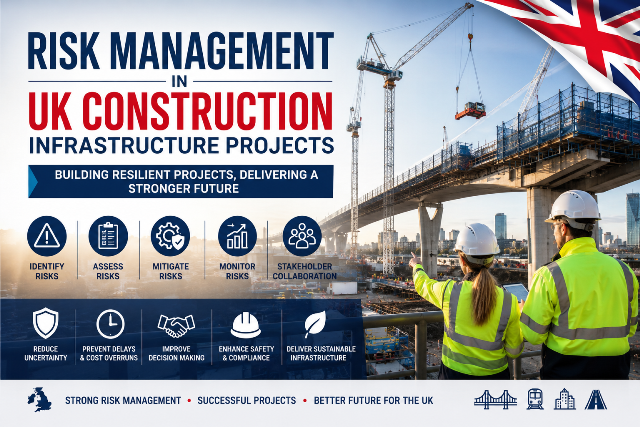
The construction industry in the United Kingdom is one of the most important sectors of the economy, supplying the relevant infrastructure needed for the social and economic development of the people. According to the Office for National Statistics (ONS, 2023),this industry to contribute about 6% of the UK’s GDP and employs more than 2 million people. Moreover, the industry provides underpinning value to the economy in vital sectors such as transport, energy, and digital infrastructure. Infrastructure development is one of the UK Government’s priorities as it influences sustainable economic growth. This is evident in the National Infrastructure Strategy (HM Treasury, 2020). The strategy aims to improve competitiveness, decarbonizes the economy, and promotes regional equity, as exposed in other Government policy documents.
Challenges Facing UK Construction Megaprojects
After understanding the significance of the recently built UK construction projects, it becomes apparent that construction risks persistent problems for the sector. In construction projects, risks such as loss of stakeholder cohesion, governance issues, time and cost overruns, among others, are key challenges to success in the construction sector. Crossrail, High Speed 2 (HS2), and the Heathrow Expansion are notable megaprojects that have performed poorly. To illustrate, the Crossrail Elizabeth Line finished three years late and cost an additional £4.5 billion (NAO, 2020) beyond its budget. In 2009, the cost of HS2 was estimated to be £37 billion, which, by 2023, had at thin creased to over £100 billion (BBC, 2023), prompting strong public and political backlash. In addition to these problems, the Heathrow Expansion project has also suffered delays due to environmental, legal, and cost issues (Coughlan, Dainty & Tunstall, 2022).
Limitations of Current Risk Management Frameworks
The universal adoption of frameworks such as PRINCE2 and ISO 31000 does not mean they are effectively used to manage UK megaprojects. Turner and Zolin (2020) argue that these frameworks address neither complexity nor multi-stakeholder environments. Cost and time overruns repeat due to systemic, governance, and risk management weaknesses. Relatively stagnant and poorly designed frameworks, governance and risk management frameworks, and oversight gaps leave gaps politically, regulatory, and technologically.
Managing these projects effectively means dealing with diverse and complex risks. Financial risks encompass macroeconomic destabilization (e.g., post Brexit and COVID environments) and inflating and shrinking project budgets. Additionally, regulatory, technological, and environmental risks are associated with complex and poorly adapted planning and environmental legislation, procurement systems, and post- and climate-adaptive challenge frameworks. Technology such as Building Information Models (BIM), digital twins, and AI enhance project performance and create cyber-security and problematic data and risk management frameworks (Pryke & Smyth, 2020). Finally, stakeholder risk, more so governance gaps, fragmentation, mistrust, and hostile, adjacent- and cross-community opposition, arise from contradictions among project sponsors, local residents, and capital financiers.
Also Read: Managing Global Teams
Significance of Effective Risk Management
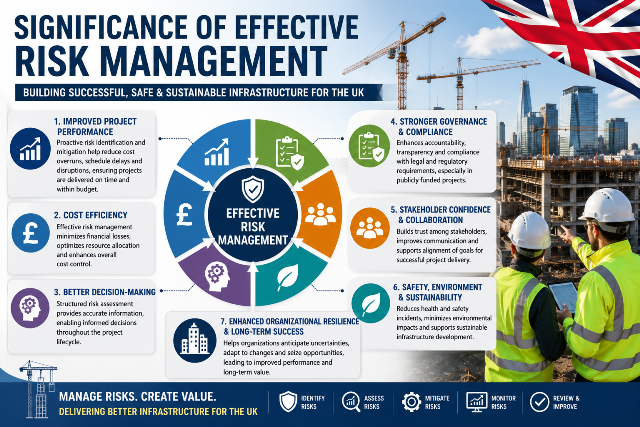
In the UK construction sector, the incessant incidence of cost and performance overruns epitomizes what Flyvbjerg (2023) describes as the “megaproject paradox”, due to optimism bias and political underestimation, costs and timeframes are chronically underestimated. This indicates the need of contextual knowledge pertaining to the effective practice of risk management. The practical and theoretical importance of effective risk management is the enhancement of project resilience, investor trust, and public confidence in the delivery of infrastructure, which, within the context of the UK, ICE (2021) argues, leads to sustainable national developmental outcomes that are socially responsible and discharged in a socially acceptable manner.
Risk Management in Construction
Research Purpose and Study Focus
To critically examine the challenges and best practices in managing risks within complex construction infrastructure projects in the United Kingdom.
Research Objectives
Following are the objectives of this research:
- To identify the key categories and sources of risk affecting UK infrastructure megaprojects.
- To evaluate existing frameworks and strategies of risk management applied in complex UK projects.
- To investigate lessons learned and best practices from mega construction projects.
- To propose strategic recommendations to improve risk management performance and governance in future UK infrastructure projects.
Key Research Questions
- What are the primary risks encountered in complex construction projects in the UK?
- How are risk management frameworks implemented within megaprojects?
- What limitations and governance weaknesses hinder effective risk management?
- What lessons and transferable best practices can be derived from recent megaprojects?
- How can strategic improvements in risk management enhance project and organizational performance?
These questions jointly guide the study toward a holistic understanding of risk governance and performance improvement in large-scale infrastructure delivery.
Scope, Importance and Limitations
An evaluation of risk management at the megaprojects is the emphasis of this research. Long-term societal benefits from large-scale capital investment projects are sought, and these projects are developed with the participation of multiple sponsors. Although the UK is the focus of the analysis, other literature and practice that are internationally comparable are thought to streamline the analysis. It will be limited to peer-reviewed academic sources, and as a matter of priority, will fall within a defined period (e.g., 1990-2024) within the construction sector. Megaprojects influence the level of the national competitiveness and economic stability, which is why they are vital to the risk management of the people. Since the projects are publicly funded, they should be subjected to risk management to provide the public with some transparency and accountability. This research is targeted at the public, private, and public-private contractors and professional institution, which in this case are the civil engineers. The study fits itself in the body of literature that explores the interaction of the complexity of these projects with the risk management, governance, and strategic management designs in the academic ecology. This literature will not cover grey or non-English literature. With the conceptual setting, it will also have a theoretical setting, which will require subsequent empirical validation.
Emerging Risks in Modern UK Infrastructure Development
The impetus for this study stems from persistent challenges regarding cost overruns, schedule delays, and governance in UK infrastructure projects, notably despite the use of established frameworks in project management, such as PRINCE2, PMBOK, and ISO 31000. This disconnects calls for more targeted, UK-specific research that considers the unique formal, political, and regulatory contexts of the UK.
National Audit Office (NAO, 2020; 2021: 2023) audit reports point out that the risk management approaches in megaprojects are reactive and siloed. Simultaneously, new technologies such as BIM, AI, and digital twins are rapidly emerging and presenting new risks for which legacy governance frameworks are poorly equipped. This study, therefore aims to bridge the gap by researching challenges and risk management best practices to inform UK landscape.
Contribution of This Research to Construction Risk Management
The research supports infrastructure projects by improving governance, fostering collaboration, and facilitating more strategic decision-making. The research objectives are driven by an overarching commitment to the principles of sustainable development, governance of public projects with social accountability and risk-informed, strategic decision making.